LA Rent Stabilization in 2026: What Changed for Apartment Owners
Q4 2026
Key Takeaways
The City of Los Angeles passed an ordinance in December 2025 that lowers how much rent can rise each year in buildings covered by the Rent Stabilization Ordinance (RSO).
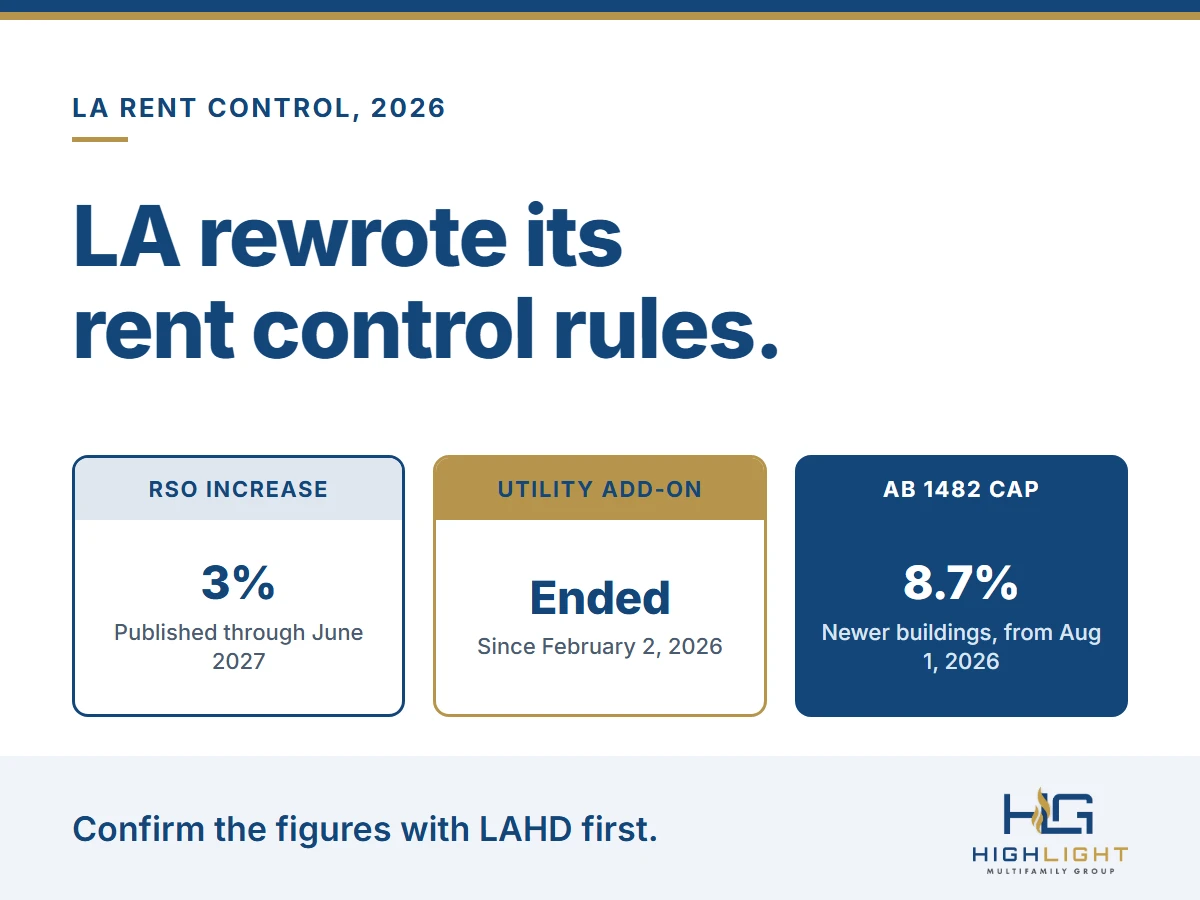
According to the Los Angeles Housing Department, since February 2, 2026 a landlord can no longer include any extra percentage for utilities in an annual increase.
The City’s published annual increase for RSO units is 3%, and a council office page states it stays at 3% through June 30, 2027. The ordinance also describes a new formula, covered below, so confirm the current number and how it applies with the Housing Department before you send a notice.
This is separate from the statewide AB 1482 cap, which applies to newer buildings and is 8.7% for increases effective on or after August 1, 2026.
Which Buildings Are Covered
The RSO generally covers apartment buildings in the City of Los Angeles with a certificate of occupancy issued before October 1, 1978. Newer buildings typically fall under the statewide cap instead. You can check a property on the City’s ZIMAS map, and the Housing Department lists a text-message lookup on its RSO page. Other cities, including Santa Monica, West Hollywood, and Beverly Hills, have their own rent control, so a building outside the City of Los Angeles follows different rules.
What the 2025 Ordinance Changed
The City Council passed the ordinance on December 12, 2025, and Mayor Bass signed it on December 23. The Apartment Association of Greater Los Angeles summarizes its main points as follows.
A new formula. The annual allowable increase is to be calculated at 90% of the Consumer Price Index for all items, down from 100%, with a ceiling of 4%, down from 8%, and a floor of 1%, down from 3%.
No utility add-on. The extra 1% previously allowed for owners who pay for gas or electricity on behalf of tenants was eliminated. The Housing Department says that beginning February 2, 2026, a landlord can no longer include any additional percentage increase for utilities.
No automatic 10% for added dependents. The separate 10% increase that had been allowed when an additional dependent was added to a tenancy was eliminated.
Relocation amounts. Relocation assistance amounts are to be adjusted each year using 100% of the CPI.
What You Can Charge Now
The Housing Department’s RSO rent increase calculator uses 3%, and a City Council office page last updated in March 2026 states that the RSO annual rent increase remains at 3% from July 1, 2025 to June 30, 2027. The Housing Department’s own announcement on its calculator page still describes the earlier period, so check it before you rely on a number.
A few practical points. State law requires 30 days’ written notice for rent increases of less than 10%. The City’s RSO and Systematic Code Enforcement Program fees can be passed through to tenants only after you register the unit and give written notice. The calculator page lists the current pass-through amounts of $1.61 and $2.83 a month.
How This Compares With AB 1482
For newer buildings outside the RSO, the statewide rent cap is the lower of 10% or 5% plus the regional CPI change. For increases effective on or after August 1, 2026, that is 8.7%. Our AB 1482 guide explains how it is calculated.
The gap is large. On a $2,000 rent, a 3% increase is $60 a month, and an 8.7% increase is $174. Over a year that is about $720 versus $2,088 per unit, which is why the two kinds of buildings are priced differently.
What It Means for Value
Buyers underwrite rents in place and the legal limit on how fast they can grow. A lower ceiling slows rent growth in an RSO building, and buyers give only partial credit for upside they cannot capture until units turn over. See our cap rates and prices by neighborhood.
As an illustration, take a 10-unit building with $2,000 rents. A 3% increase adds $7,200 a year in rent. At a 6% cap rate, that income is worth about $120,000 to a buyer, and expenses that do not rise with rent mean most of it reaches net operating income. This is an example, not a quote for your building, but it shows why an unused allowable increase has value.
Before you list, ask whether to take an allowable increase you have not yet used. Notices have to be served properly, and timing relative to a listing matters. A free Broker Opinion of Value can show what the increase is worth to a buyer.
Selling an RSO Building
The rent rules stay with the building, so a buyer steps into your position. Have your RSO registration and fee records, rent increase notices, and rent roll ready. Our guide to selling with tenants under rent control walks through what buyers ask for, and our property value calculator gives a quick range.
This article is general information, not legal advice. Rent rules change, so please confirm the current figures with the Los Angeles Housing Department or an attorney before you serve any notice.
Sources
Los Angeles Housing Department: RSO Rent Increase Calculator
Councilmember Nithya Raman, Council District 4: Renters Rights and Protections
Apartment Association of Greater Los Angeles: L.A. RSO Formula Change
Frequently Asked Questions
How much can I raise rent on a rent-stabilized unit in Los Angeles in 2026?
The City’s Rent Stabilization Ordinance calculator uses 3%, and a City Council office page states the annual increase remains at 3% from July 1, 2025 to June 30, 2027. Confirm the current figure with the Los Angeles Housing Department before you send a notice.
Can I still add an extra 1% for utilities on an RSO unit?
No. The Los Angeles Housing Department says that beginning February 2, 2026, a landlord can no longer include any additional percentage increase for utilities in an annual rent increase.
What is the new RSO rent increase formula?
According to the Apartment Association of Greater Los Angeles, the ordinance sets the annual allowable increase at 90% of the Consumer Price Index for all items, with a ceiling of 4% and a floor of 1%. Confirm with the Housing Department how it applies to your notice date.
Which Los Angeles buildings are covered by the RSO?
Generally apartment buildings in the City of Los Angeles with a certificate of occupancy issued before October 1, 1978. Newer buildings typically fall under the statewide AB 1482 cap, which is 8.7% for increases effective on or after August 1, 2026.
How much notice do I have to give for a rent increase?
State law requires 30 days’ written notice for rent increases of less than 10%. The Housing Department also notes that RSO and Systematic Code Enforcement Program fees can be passed through to tenants only with proper written notice.
How does the lower RSO cap affect what my building is worth?
It limits how fast rents can grow, and buyers give only partial credit for upside they cannot capture until units turn over. A free Broker Opinion of Value shows how buyers would price your building today.