
Why LA Apartment Owners Are 1031 Exchanging Into Triple-Net Properties
Q3 2026
What Is a 1031 Exchange?
A 1031 exchange, named for Section 1031 of the Internal Revenue Code, lets you sell an investment property and defer the capital gains tax you would otherwise owe, as long as you reinvest the proceeds into another investment property of equal or greater value. The tax isn’t eliminated; it’s deferred until you eventually sell without exchanging again.
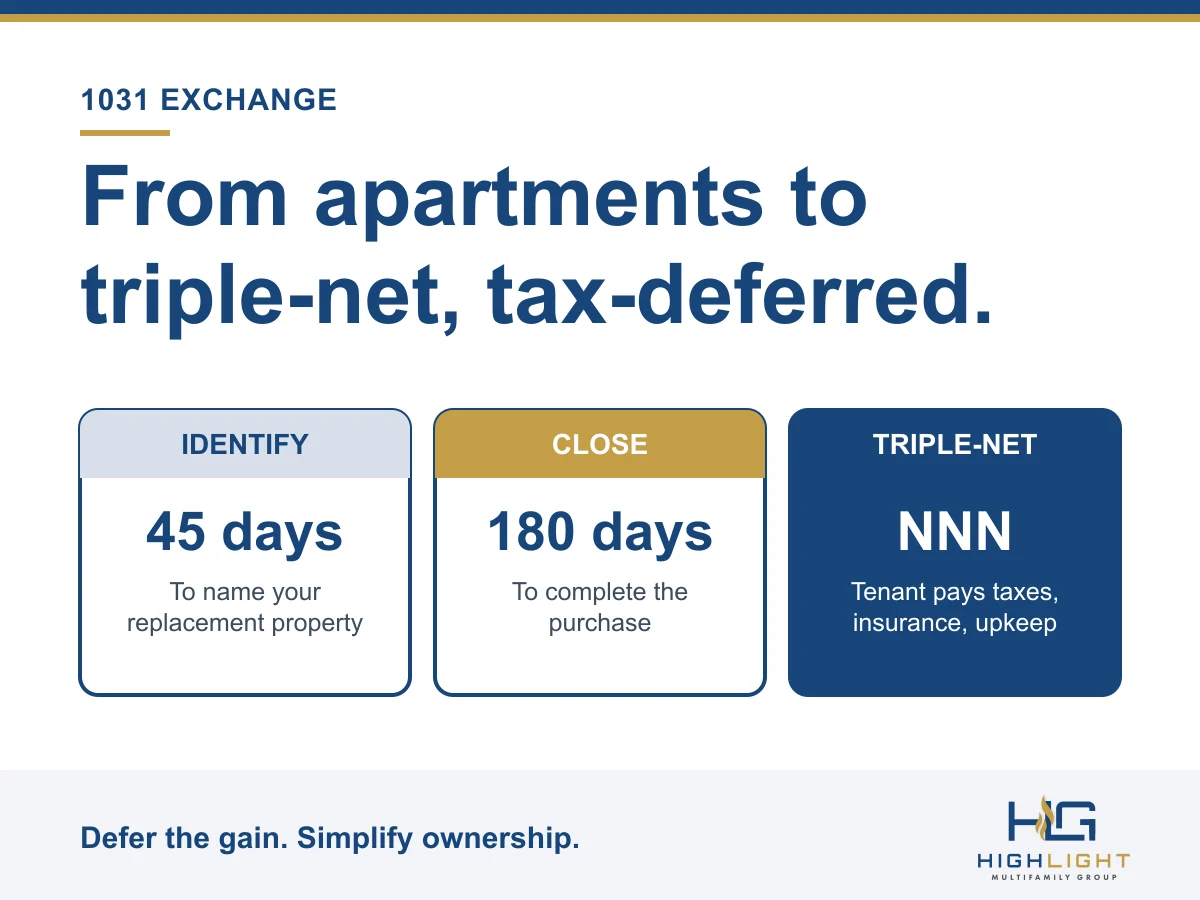
The catch is that you can never touch the sale proceeds directly. A Qualified Intermediary (QI) holds the funds from your sale and uses them to purchase your replacement property on your behalf, and the entire process runs against two strict IRS deadlines, shown below, that determine whether the exchange holds up.
When Active Management Stops Making Sense
Owning an apartment building in Los Angeles has gotten harder, not easier, over the last several years. Statewide rent control under AB 1482, local rent stabilization ordinances, rising insurance costs, and the day-to-day reality of tenant turnover and deferred maintenance have pushed a growing number of long-term owners to ask the same question: does this still make sense for me?
For owners nearing retirement, managing a portfolio from out of state, or simply tired of the 2 a.m. phone calls, the answer is often no. But selling outright means a large capital gains tax bill. That is where a 1031 exchange into a triple-net (NNN) property comes in.
How a 1031 Exchange Makes the Move Tax-Deferred
Multifamily and commercial real estate both qualify as "like-kind" to each other under current tax code, which is what makes an apartment-to-NNN exchange possible in the first place. Once your relinquished property closes escrow, the clock starts on the two deadlines below. Both are hard cutoffs set by the IRS, not guidelines. We start sourcing replacement options before your sale even closes, specifically to protect that window rather than scramble against it.
- 45-Day Identification Window
- 180-Day Exchange Window
Why Triple-Net (NNN) Properties Specifically
In a triple-net lease, the tenant, not the owner, is responsible for property taxes, insurance, and maintenance. For an owner used to fielding maintenance calls and coordinating repairs on an apartment building, that structure is the whole appeal: rent arrives, and there is no roof to fix.
NNN properties are also typically leased to a single commercial tenant on a long-term lease, which means the day-to-day tenant management that comes with dozens of residential units simply goes away. And because NNN opportunities exist all over the country, an exchange out of an LA apartment building is also a natural way to diversify geographically and step outside California-specific rent control exposure entirely.
A Recent Example: One LA Building, Two NNN Properties
We recently guided a client through exactly this kind of exchange: she sold her 24-unit apartment building here in Los Angeles (1136 S Alvarado St) and exchanged the proceeds into two separate triple-net properties, one in Florida and one in Georgia. Splitting the exchange across two assets in two different states let her diversify both her tenant risk and her geographic exposure in a single transaction, while fully deferring the capital gains tax on the sale.
As with any multi-property, multi-state exchange, the work was in the coordination: keeping both replacement acquisitions moving in parallel against the same 45- and 180-day clock, and working with NNN specialists in each market to get her comfortable with the tenant, lease terms, and location before committing.
Is an NNN Exchange Right for Your Building?
Not every owner should exchange into a triple-net property, and not every apartment building is the right one to sell right now. The first conversation is always about your goals: are you trying to stop managing property altogether, reduce your workload without fully exiting real estate, or move capital out of California? The right answer changes the strategy.
If you are considering a sale and want to understand what a 1031 exchange into a passive NNN investment could look like for your specific building, we would be glad to walk through it with you.
Frequently Asked Questions
I am tired of being a landlord. How can I sell my apartment building without a huge tax bill?
Owning an apartment building in Los Angeles has gotten harder, with statewide rent control under AB 1482, local rent stabilization ordinances, rising insurance costs, and tenant turnover pushing many long-term owners to ask whether it still makes sense. Selling outright means a large capital gains tax bill. A 1031 exchange into a triple-net (NNN) property lets you defer that tax while moving into a passive investment with no apartment management, and it is often the answer for owners nearing retirement, managing from out of state, or simply tired of the 2 a.m. phone calls.
What is a 1031 exchange, in simple terms?
Named for Section 1031 of the Internal Revenue Code, a 1031 exchange lets you sell an investment property and defer the capital gains tax you would otherwise owe, as long as you reinvest the proceeds into another investment property of equal or greater value. The tax is not eliminated, only deferred until you eventually sell without exchanging again.
What are the 45-day and 180-day rules for a 1031 exchange?
There are two strict IRS deadlines, and both are hard cutoffs, not guidelines: 45 days to identify a replacement property and 180 days to close on it. You can never touch the sale proceeds directly. A Qualified Intermediary holds the funds from your sale and uses them to buy your replacement property on your behalf. See our 1031 exchange guide.
Can I sell my apartment building and buy a triple-net (NNN) property with a 1031 exchange?
Yes. Multifamily and commercial real estate both qualify as like-kind to each other under current tax code, which is what makes an apartment-to-NNN exchange possible.
What does triple net lease mean for a landlord, and why do owners want one?
In a triple-net lease, the tenant, not the owner, is responsible for property taxes, insurance, and maintenance. NNN properties are also typically leased to a single commercial tenant on a long-term lease, so the day-to-day tenant management that comes with dozens of residential units goes away. Because NNN opportunities exist all over the country, an exchange also lets an owner diversify geographically and step outside California rent control exposure.
Is there a real example of someone trading an LA apartment building for NNN properties?
We guided a client who sold her 24-unit apartment building at 1136 S Alvarado St and exchanged the proceeds into two separate triple-net properties, one in Florida and one in Georgia. Splitting the exchange diversified both her tenant risk and her geographic exposure while fully deferring the capital gains tax on the sale.
Is an NNN exchange right for my apartment building?
Not every owner should exchange into a triple-net property, and not every apartment building is the right one to sell right now. The first conversation is about your goals: stopping management altogether, reducing your workload without fully exiting real estate, or moving capital out of California. See our triple-net and DST page, or request a free Broker Opinion of Value to start.