
Capital Gains and Depreciation Recapture When You Sell an LA Apartment Building
Q4 2026
Why the Tax Bill Surprises Many Owners
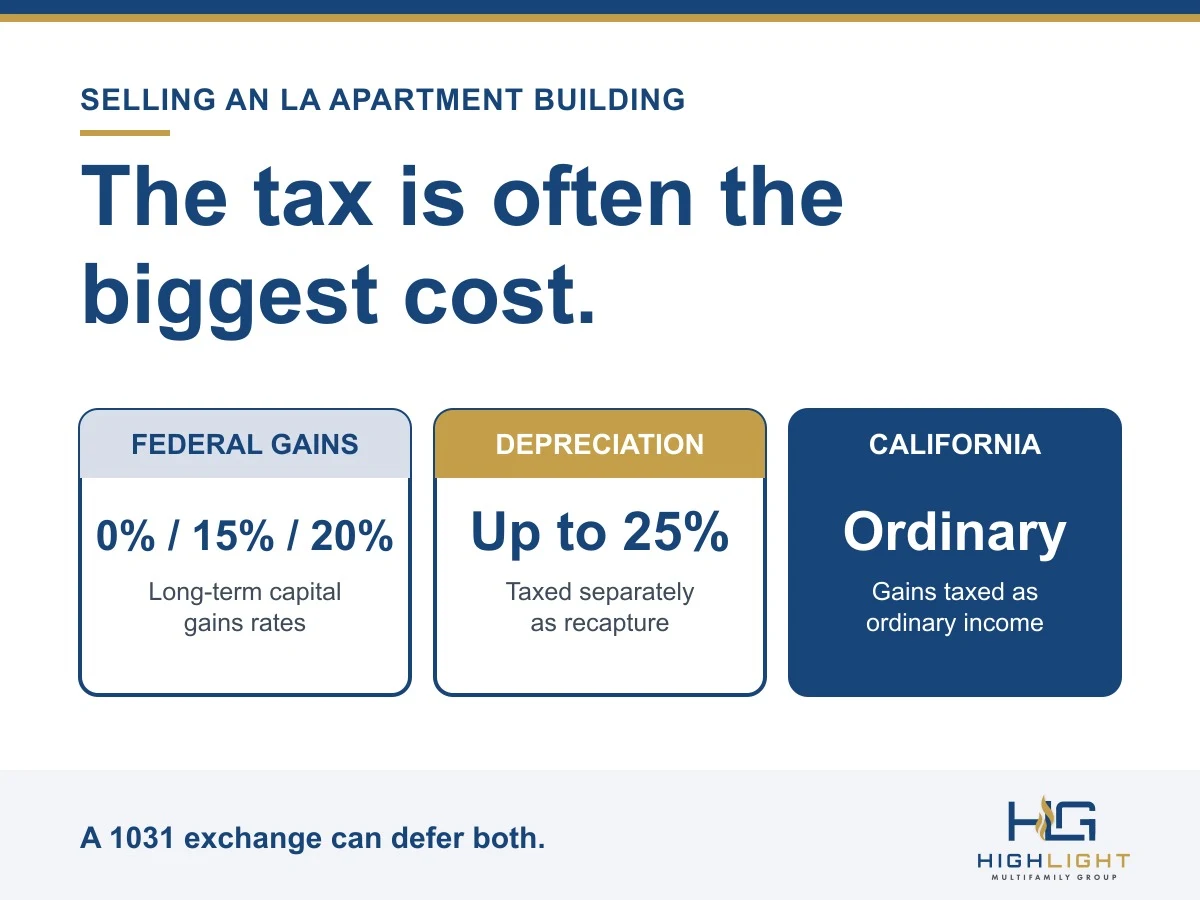
For many apartment owners, the biggest cost of selling is not the commission. It is the tax. Owners who bought years ago, and who have been taking depreciation deductions every year since, are often surprised by how much of the sale price is taxable. Understanding the pieces before you list lets you plan around them instead of discovering them at closing.
How Your Gain Is Figured
Your taxable gain is generally the amount you realize from the sale, after selling costs, minus your adjusted basis. Your adjusted basis starts with what you paid for the property, adds the cost of capital improvements, and subtracts the depreciation you took or were allowed to take. Because depreciation lowers your basis every year, a building that has been depreciated for decades can have a basis far below what you paid.
Federal Capital Gains Tax
If you owned the property for more than a year, the gain is generally a long-term capital gain, taxed at 0%, 15%, or 20% federally depending on your taxable income. According to the IRS, the 20% rate applies once income is above the threshold for the 15% rate, and those thresholds are adjusted every year. Sellers with a large gain often land in the 15% or 20% bracket, because the gain itself counts toward taxable income.
High-income sellers may also owe the 3.8% net investment income tax, which applies to net gains from selling real estate when income is above certain levels, for example $200,000 for a single filer and $250,000 for a married couple filing jointly.
Depreciation Recapture
Residential rental property is generally depreciated over 27.5 years, which gives owners a deduction every year they hold it. When you sell, the part of your gain that comes from that depreciation is not taxed at the regular capital gains rates. The IRS treats it as unrecaptured section 1250 gain, taxed at a maximum federal rate of 25%. The IRS generally measures this by the depreciation you were allowed to take, whether or not you claimed it, so it is not something an owner can avoid by skipping the deductions.
In plain terms: the depreciation deductions lowered your taxes while you owned the building, and when you sell, the IRS takes some of that benefit back. The amount of depreciation you took becomes the first slice of your gain and is taxed at up to 25%; any growth in price beyond that is taxed at the regular capital gains rates. The example below walks through the numbers.
- 1. You bought the building$1,000,000
- 2. Over the years, you deducted depreciation−$400,000
- 3. So your "tax cost" (adjusted basis) is now$600,000
- $600,000: your basis back. Not taxed. This is the part of your investment you have not already deducted.
- $400,000: depreciation recapture. The deductions you took come back as gain, taxed at up to 25% federally (at most $100,000).
- $1,000,000: price growth. Regular long-term capital gain, taxed at 0%, 15%, or 20% federally (at most $200,000).
Total taxable gain: $1,400,000. Federal figures only; the 3.8% net investment income tax may also apply, and California taxes the entire gain as ordinary income. A simplified illustration, not tax advice.
California Taxes the Gain Too
California does not have a lower rate for capital gains. According to the Franchise Tax Board, all capital gains are taxed as ordinary income. For a seller with a large gain, that means the state tax can be substantial on top of the federal tax.
Ways Owners Manage the Tax
There are legitimate ways to reduce, defer, or time the tax, and the right one depends on your situation. A few of the most common are below.
A 1031 exchange. If you reinvest the proceeds into like-kind investment property, you can defer both the capital gains tax and the depreciation recapture. The rules are strict, including 45 days to identify a replacement property and 180 days to close. Read our 1031 exchange guide and our article on exchanging into triple-net properties.
Timing the sale. Closing in December or January puts the gain in a different tax year, which can matter for your overall income. See our article on timing a sale before year-end.
Estate planning. Property inherited at death generally receives a new, stepped-up basis, which can eliminate much of the gain for heirs. If you are handling a building after an owner’s death, see our trust and estate sales page.
Records. Keep documentation of capital improvements you have made over the years, since they add to your basis and reduce your gain.
Do Not Forget the Other Costs of Selling
Income tax is only part of what comes out of a sale. If your building is priced near $5.4 million or $10.9 million inside the City of Los Angeles, the Measure ULA transfer tax can matter just as much, as we explain in our Measure ULA guide. And if you are still deciding whether selling makes sense, our seven questions to ask first is a good place to start.
Plan Before You List
The best time to talk about taxes is before you list, not after you are under contract. Bring your CPA into the conversation early, and we will help with the real estate side: what your building is likely to sell for, what a buyer will pay, and how timing and structure affect your options. Start with our free property value calculator or request a free Broker Opinion of Value.
This article is general information, not tax or legal advice. Tax rules and income thresholds change, so please confirm everything with your CPA or tax attorney.
Sources
IRS Topic No. 409: Capital gains and losses
IRS Topic No. 559: Net investment income tax
IRS Publication 527: Residential Rental Property
Frequently Asked Questions
How much tax will I pay if I sell my rental property in California?
If you owned the property for more than a year, the gain is generally a long-term capital gain, taxed federally at 0%, 15%, or 20% depending on your taxable income. Depreciation recapture is taxed at up to 25%, high-income sellers may owe the 3.8% net investment income tax, and California taxes the gain as ordinary income.
What is depreciation recapture, and why am I taxed on it when I sell?
Residential rental property is generally depreciated over 27.5 years. When you sell, the part of your gain that comes from that depreciation is treated by the IRS as unrecaptured section 1250 gain, taxed at a maximum federal rate of 25%. The IRS generally measures it by the depreciation you were allowed to take, whether or not you claimed it.
How do I figure out my taxable gain when I sell my rental property?
Your taxable gain is generally the amount you realize from the sale, after selling costs, minus your adjusted basis. Your adjusted basis starts with what you paid for the property, adds the cost of capital improvements, and subtracts the depreciation you took or were allowed to take.
Does California have a lower tax rate on capital gains from selling real estate?
No. According to the California Franchise Tax Board, all capital gains are taxed as ordinary income, so for a seller with a large gain the state tax can be substantial on top of the federal tax.
How can I defer capital gains tax when I sell my rental property? Does a 1031 exchange work?
Yes. If you reinvest the proceeds into like-kind investment property, you can defer both the capital gains tax and the depreciation recapture. The rules are strict, including 45 days to identify a replacement property and 180 days to close. See our 1031 exchange guide.
Do I owe capital gains tax if I inherit an apartment building and sell it?
Property inherited at death generally receives a new, stepped-up basis, which can eliminate much of the gain for heirs. If you are handling a building after an owner’s death, see our trust and estate sales page, and confirm the details with your CPA or tax attorney.