
AB 628: California’s Stove and Refrigerator Law for Rental Units
Q4 2026
Key Takeaways
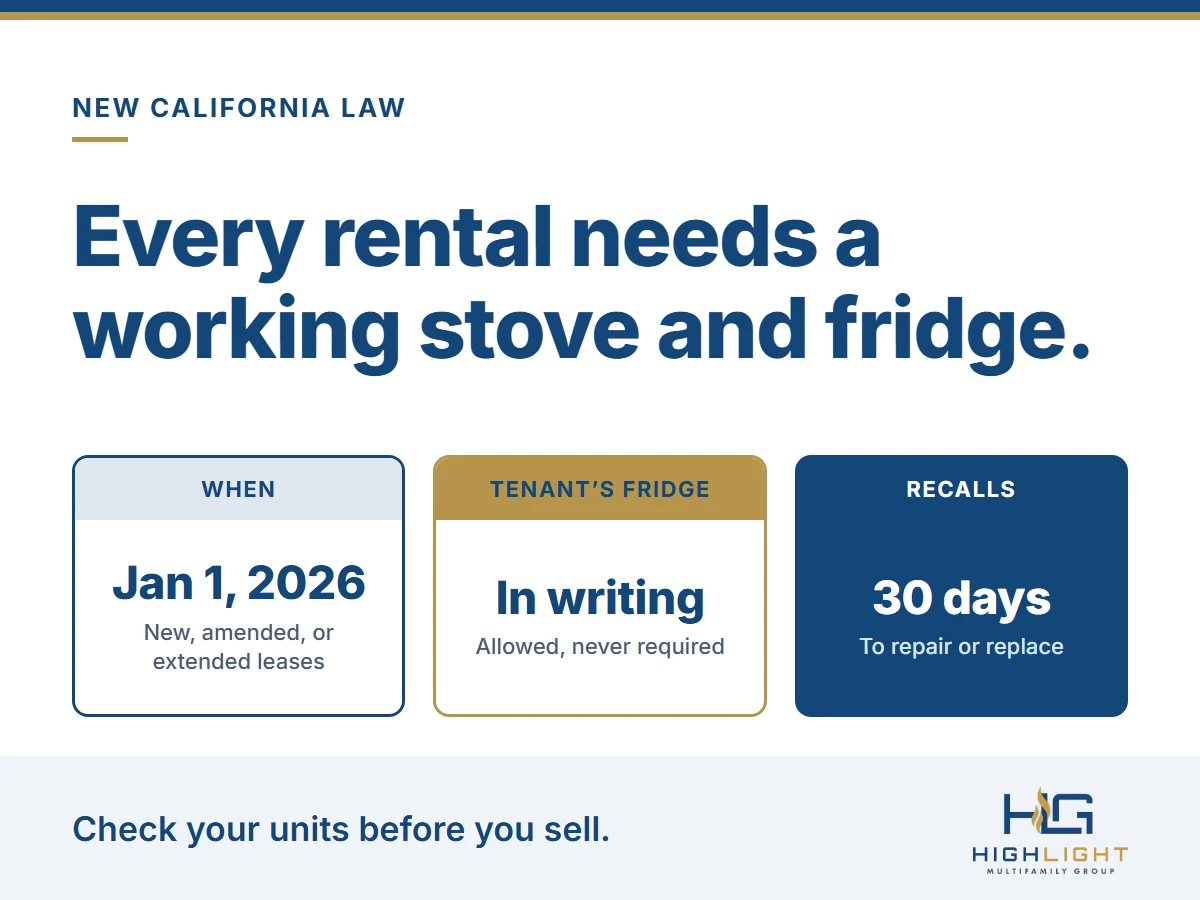
AB 628, signed October 6, 2025, adds a working stove and a working refrigerator to the list of things a California rental unit must have to be considered tenantable.
It applies to leases entered into, amended, or extended on or after January 1, 2026.
A tenant may supply their own refrigerator, but only under rules written into the lease, and a landlord cannot make it a condition of renting. The law has no similar option for stoves.
Some housing is exempt, including single-room occupancy units and units with shared kitchens. For an owner preparing to sell, an appliance check is a simple way to avoid surprises in due diligence.
What the Law Requires
AB 628 amends Civil Code section 1941.1, the list of characteristics a dwelling needs so that it is not considered untenantable. The list already includes things like weatherproofing, plumbing, heating, and electrical service. For covered leases it now also includes:
A stove that is maintained in good working order and capable of safely generating heat for cooking purposes.
A refrigerator that is maintained in good working order and capable of safely storing food.
The statute treats a stove or refrigerator that is subject to a recall by the manufacturer or a public entity as not capable of safely cooking or storing food.
Which Leases Are Covered
The new requirements apply only to a lease that is entered into, amended, or extended on or after January 1, 2026. A new lease signed this year is covered. A renewal or an amended lease is covered as well. The statute speaks of leases, and does not say how it treats a month-to-month tenancy that simply continues, so ask your attorney how to handle those units. The safest approach is to plan on every unit meeting the standard.
The Tenant-Supplied Refrigerator Option
Older buildings often have tenants who bring their own refrigerator. The law allows that, with conditions. The landlord and tenant must agree when the lease is signed, and the lease must include a statement in substantially this form: that under state law the landlord is required to provide a refrigerator in good working order, and that by checking the box the tenant acknowledges they asked to bring their own and are responsible for keeping it in working order.
The lease must also say the tenant can give 30 days’ written notice that they no longer want to keep their own refrigerator, and that at the end of the 30 days the landlord will install one in good working order. A landlord may not condition the tenancy on the tenant providing a refrigerator, and is not responsible for maintaining one the tenant provides.
The statute offers no equivalent arrangement for stoves, so plan on supplying the stove.
Recalls: The 30-Day Rule
If a stove or refrigerator is subject to a recall by the manufacturer or a public entity, the landlord must repair or replace it within 30 days of receiving notice of the recall. The statute does not say who must give that notice. The 30-day period does not take away any remedy the tenant already has under Civil Code section 1942, which lets a tenant repair dilapidations that make the premises untenantable, or move out, when a landlord neglects them.
It is worth checking your appliances’ make and model numbers against the U.S. Consumer Product Safety Commission’s recall database.
Who Is Exempt
The stove and refrigerator requirements do not apply to permanent supportive housing, to single-room occupancy units that provide living and sleeping space for the occupant’s exclusive use (including those where occupants share food preparation facilities), to units in a residential hotel, or to dwelling units in a facility with shared or communal kitchen spaces, including assisted living facilities.
What Happens If a Unit Falls Short
The bill creates no separate fine. The consequence is that a unit that substantially lacks a working stove or refrigerator is deemed untenantable under section 1941.1, and the tenant’s existing remedies for untenantable housing apply. That is why an appliance that is missing, broken, or recalled is a real exposure and not a technicality.
Why This Matters When You Sell
A buyer’s inspection and unit walk-throughs will turn up missing, old, or tenant-owned appliances. If several units have them, a buyer may ask for a price credit or fold the cost into their offer. Getting ahead of it costs less than negotiating it in escrow.
Before you list: walk the units and list each stove and refrigerator, noting who owns it and its age. Look up recalls. Replace what is broken. For tenant-owned refrigerators, document the lease language the statute requires when each lease is signed or renewed. Keep the records with your lease files so they are ready for buyers. Our step-by-step guide to selling lists the other documents buyers ask for.
AB 628 is part of a run of recent habitability rules that affect older buildings, along with SB 721 balcony inspections and the air conditioning rules and electrical panels. Buyers price the combined cost, so a clear picture of what is done and what is left helps your sale.
Talk With Us
If you are thinking about selling an older building, request a free Broker Opinion of Value and we will tell you which items buyers in your neighborhood are likely to raise. Or start with the free property value calculator.
This article is general information, not legal advice. Please confirm how AB 628 applies to your leases with an attorney.
Sources
Frequently Asked Questions
Do California landlords have to provide a stove and refrigerator?
Yes, for leases entered into, amended, or extended on or after January 1, 2026. AB 628 added a working stove and a working refrigerator to the list of things a rental unit must have to be tenantable. Some housing types are exempt.
Can a tenant bring their own refrigerator under AB 628?
Yes, with conditions. The landlord and tenant must agree when the lease is signed, the lease must include the statement the law prescribes, and the tenant can give 30 days’ written notice to have the landlord install one. A landlord cannot require a tenant to bring a refrigerator. There is no similar option for stoves.
What happens if a stove or refrigerator is recalled?
The landlord must repair or replace it within 30 days of receiving notice of the recall. A recalled appliance is treated as not safe for cooking or storing food. You can check models against the CPSC recall database.
Which rental units are exempt from AB 628?
Permanent supportive housing, single-room occupancy units, units in a residential hotel, and dwelling units in a facility with shared or communal kitchens, including assisted living facilities.
What is the penalty if my rental unit has no stove or refrigerator?
AB 628 sets no separate fine. A unit that substantially lacks a working stove or refrigerator is treated as untenantable, which gives the tenant the remedies California law already provides for untenantable housing.
Should I check my appliances before selling my apartment building?
Yes. Buyers walk the units, and missing, old, or tenant-owned appliances can lead to price credits. List each unit’s stove and refrigerator, look up recalls, replace what is broken, and keep the required lease language on file. See our guide to selling step by step.