
El Niño Emergency Declared: What LA Apartment Owners Should Know
Q3 2026
What Was Declared
On September 21, 2026, Governor Newsom proclaimed a statewide state of emergency ahead of what forecasters expect to be a very strong El Niño this winter. The proclamation cites a better than 90% chance of a very strong event, and it directs state agencies to pre-position flood-fighting supplies, equipment, and personnel before the storms arrive.
Local governments have followed. The City of Long Beach proclaimed a local emergency the same day, and Los Angeles County Supervisor Hilda Solis issued a county proclamation on September 23. These declarations are mostly about preparedness and coordination, but for apartment owners they also raise a practical question about rent increases.
What It Means for Rent Increases
When a governor declares an emergency, California’s price gouging law (Penal Code section 396) ordinarily kicks in automatically. Among other things, it generally prohibits landlords from raising rents more than 10% above pre-emergency levels. According to the California Apartment Association, the governor’s El Niño proclamation expressly suspends those restrictions “at this time,” so the statewide declaration does not currently impose the 10% cap. The governor could change that later.
Local emergency declarations are a separate question. The California Apartment Association notes that a local declaration can trigger its own price gouging protections independent of the state proclamation. The news coverage we reviewed of the LA County and Long Beach proclamations did not address rent limits either way, so an owner planning an increase above 10% should confirm the rules for their city with an attorney or apartment association before sending the notice.
Your normal limits still apply regardless. If your building is covered by the LA Rent Stabilization Ordinance or by AB 1482, those caps are unaffected. For the current AB 1482 numbers, see our article on the 2026 AB 1482 rent cap.
Why Older LA Buildings Are the Most Exposed
Los Angeles apartment buildings are often older, and older buildings tend to have the features that struggle in a heavy, sustained rain: flat roofs that pond water, parapets and roof flashing that have aged, and drains and downspouts that have not been cleaned or tested in years. Subterranean and driveway-level parking can take on water fast when drainage backs up. A small amount of maintenance now is far cheaper than a five-figure repair in January.
What Mom-and-Pop Owners Should Do Before the Rains
Check rent increases first. Before sending any increase above 10%, confirm whether a local emergency order applies to your city, as described above.
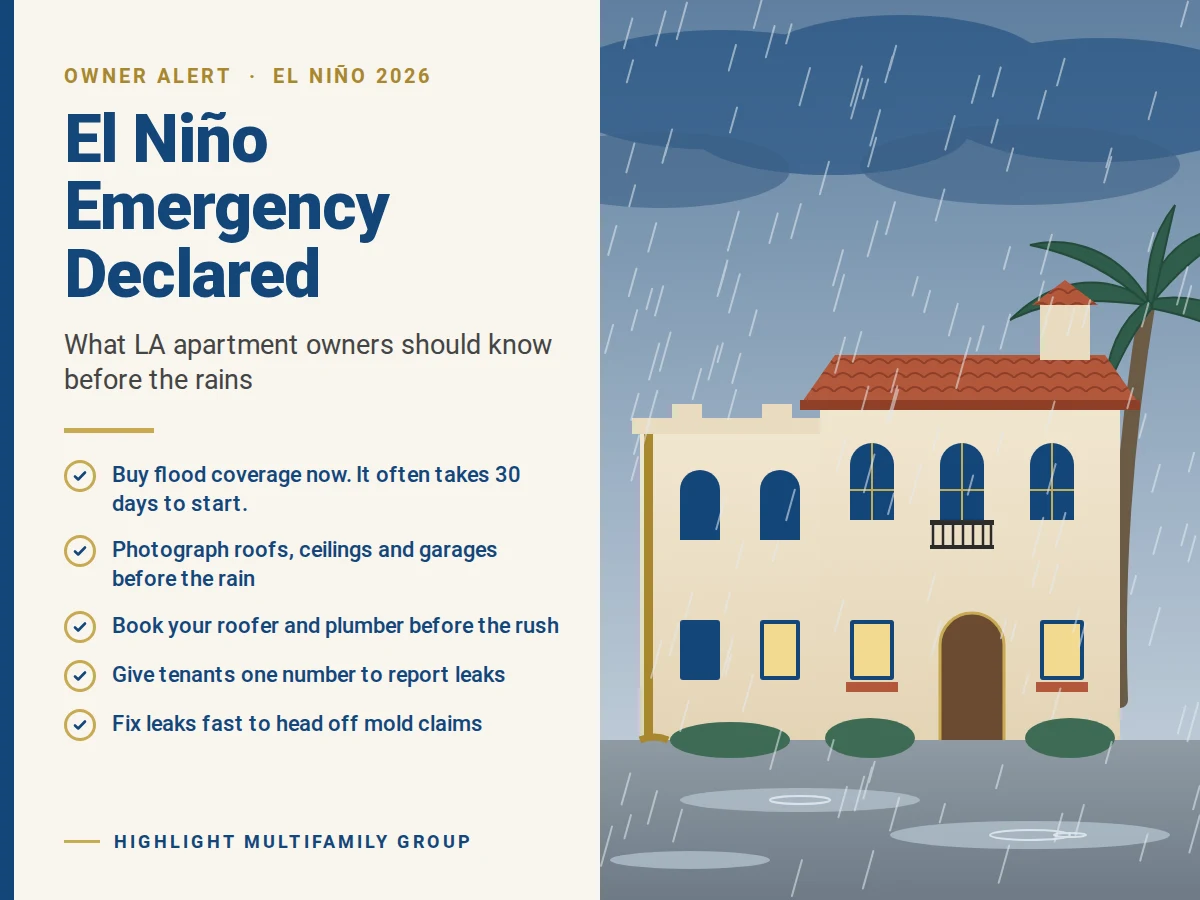
Clear and test your drainage. Clear roofs, gutters, and downspouts, and test drains and sump pumps in driveways and subterranean parking.
Treat leaks as a habitability issue. California law requires rental housing to be kept habitable, which includes weather protection and working drainage. A slow response to a leak can turn into mold complaints, withheld rent, or a code enforcement case. Fix leaks quickly and keep a record of each repair.
Review your insurance now. Standard property insurance policies generally exclude flood damage. Flood policies through the National Flood Insurance Program usually do not take effect until 30 days after purchase, so waiting for the first storm is too late. While you are at it, check your deductible and whether you carry loss-of-rents coverage.
Take photos and video today. A record of your roof, ceilings, and parking areas before the rain makes an insurance claim much easier to prove.
Line up contractors early. Roofers, plumbers, and water damage cleanup companies get booked solid once the storms start, so have their numbers ready before you need them.
Tell your tenants the plan. Give them one number or email address to report leaks, and show them where the water shutoff is. Non-emergency inspections still generally require 24 hours’ written notice before entering a unit.
If you own on a hillside or near a recent burn area, take extra care. Buildings below slopes or near the Palisades and Eaton burn areas face added risk from mudflows and debris flows, so check drainage and retaining walls first. Los Angeles County Public Works offers property-specific preparedness guidance at 800-933-0930, and more information is at ready.lacounty.gov.
Deferred Maintenance and Your Building’s Value
A wet winter has a way of exposing deferred maintenance, and buyers price it in. If you are thinking about selling, or just want to know where your building stands, we are glad to take a look. Start with a free Broker Opinion of Value, or try our free property value calculator.
This article is general information, not legal, insurance, or tax advice. Rules can change as emergency declarations are updated, so please confirm the details for your property with a qualified professional.
Sources
Governor’s El Niño emergency proclamation, September 21, 2026
MyNewsLA: Solis issues LA County emergency proclamation ahead of El Niño
NBC Los Angeles: Long Beach declares local emergency over possibly strong El Niño season
Frequently Asked Questions
Is there an El Niño state of emergency in California, and what does it mean for my rental property?
Yes. On September 21, 2026, Governor Newsom proclaimed a statewide state of emergency ahead of what forecasters expect to be a very strong El Niño this winter, citing a better than 90% chance of a very strong event. The City of Long Beach proclaimed a local emergency the same day, and Los Angeles County Supervisor Hilda Solis issued a county proclamation on September 23.
Can I raise rent during a state of emergency in California?
Not currently at the state level. California’s price gouging law (Penal Code section 396) ordinarily kicks in when an emergency is declared and generally prohibits raising rents more than 10% above pre-emergency levels, but according to the California Apartment Association, the governor’s proclamation expressly suspends those restrictions “at this time.” The governor could change that later, and a local declaration can trigger its own protections, so confirm the rules for your city with an attorney or apartment association before sending an increase above 10%.
Does rent control still apply during a state of emergency?
Yes. If your building is covered by the LA Rent Stabilization Ordinance or by AB 1482, those caps are unaffected. For the current AB 1482 numbers, see our article on the 2026 AB 1482 rent cap.
Does my landlord insurance cover flood damage, and do I need flood insurance for my rental property?
Standard property insurance policies generally exclude flood damage. Flood policies through the National Flood Insurance Program usually do not take effect until 30 days after purchase, so waiting for the first storm is too late. Also check your deductible and whether you carry loss-of-rents coverage.
How do I get my apartment building ready for heavy rain and El Niño?
Clear and test your drainage, including roofs, gutters, downspouts, and sump pumps in driveways and subterranean parking. Fix leaks quickly and keep a record of each repair, take photos and video of your roof, ceilings, and parking areas today, line up roofers and plumbers early, and give tenants one number or email address to report leaks. Non-emergency inspections still generally require 24 hours’ written notice before entering a unit.
Why do older LA apartment buildings leak or flood more in heavy rain?
Older buildings tend to have flat roofs that pond water, parapets and roof flashing that have aged, and drains and downspouts that have not been cleaned or tested in years. Subterranean and driveway-level parking can also take on water fast when drainage backs up. A wet winter exposes deferred maintenance, and buyers price it in.