
Why Diligent LA Apartment Owners Track Their Utility Bills Every Month
Q3 2026
An Expense Owners Often Overlook
Rent collection gets constant attention. Every owner knows exactly who paid, who is late, and what is owed. Utility bills rarely get the same scrutiny. They get paid on autopilot, whether by the owner directly or by a property management company, and the assumption is usually that the number is just what it is that month.
That assumption is the problem. A water, sewer, or gas bill is not a fixed cost. It moves for real reasons, and one of the most common reasons is one nobody wants: a leak that started running and never got noticed.
The Real Risk: A Leak That Runs for Months
In our experience, the biggest risk is not a one-time billing error. It is usually a plumbing leak that starts quietly, does not get caught, and keeps running for months, sometimes closer to a year, before anyone connects it to the bill.
A leak like that does not announce itself. It just shows up as a slightly higher number every month, easy to miss if nobody is actually comparing bills month over month.
What We See When We Take On a New Listing
When we first put together a Broker Opinion of Value, we work from normalized expenses, a reasonable estimate of what the property should be running. It is not until we actually sign the listing and pull the real bills, water, sewer, trash, insurance, that we get a true picture of how the property has actually been operating.
This has happened to us more than once. In the last 12 months alone, it happened twice.
On one property, a 10-unit building in Pico-Union managed by a professional property management company, we noticed a large jump in the water bill that had started roughly a year earlier and never came back down. We recommended bringing in a plumber to check the property for leaks. They found one. Once it was fixed, the water bill normalized almost immediately. That undetected leak cost the owner about $8,000 in extra water expense that could have been avoided if it had been caught when it started.
On another property, a 7-unit building in Koreatown, the same pattern played out on a smaller scale. We caught the jump, recommended a plumber, and a leak was found and fixed. That one saved the owner roughly $4,000.
Translating an $8,000 Water Bill Into $114,000 of Lost Value
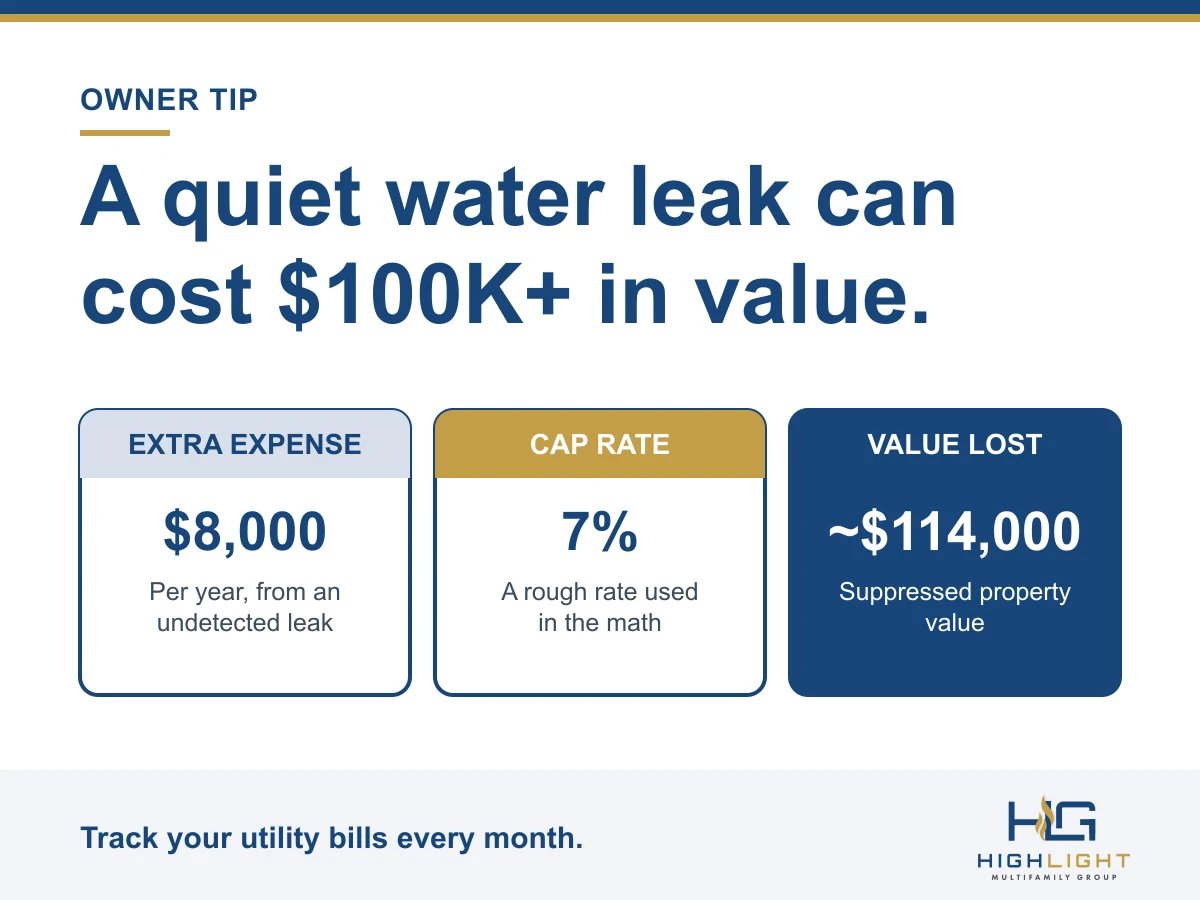
$8,000 or $4,000 a year does not sound like a lot of money on its own. But an apartment building is not valued on its expenses in isolation, it is valued on its net operating income, capitalized at a market cap rate. Using a rough 7% cap rate, that extra $8,000 a year in water expense translates to roughly $114,000 in suppressed property value. The $4,000 overspend translates to roughly $57,000.
That is the part that catches most owners off guard. A leak that seems like a maintenance headache is actually a value problem, and at the cap rates apartment buildings trade at, a fairly small monthly overspend has an outsized, almost exponential effect on what the property is ultimately worth.
The Best Way to Catch It: Track Your Expenses as a Percentage
Our advice to owners is simple: do not just track whether a utility bill was paid, track what percentage of your total monthly expenses that bill represents, in a spreadsheet, updated every month.
Watch that percentage over time. If your water bill jumps from making up roughly 35% of your monthly expenses one month to 45% the next, that kind of jump is a red flag on its own, regardless of the dollar amount, and it is reason enough to get a plumber out to check for leaks before it runs for another month, let alone another year.
Proactive Diligence Pays Off, Whether or Not You Are Selling
Even if you have no plans to sell right now, catching a leak early instead of a year later is real, ongoing savings straight to your bottom line. And if you are getting ready to bring a property to market, cleaning up an expense like this before you list is one of the more direct ways to protect, or improve, what you can ask for it.
If you are not sure whether your property’s expenses are running the way they should be, we are glad to take a look.
Frequently Asked Questions
Can a water leak lower the value of my apartment building?
An apartment building is valued on its net operating income, capitalized at a market cap rate. Using a rough 7% cap rate, an extra $8,000 a year in water expense translates to roughly $114,000 in suppressed property value, and an extra $4,000 translates to roughly $57,000. A leak that seems like a maintenance headache is actually a value problem.
My water bill went up. How do I know if my apartment building has a leak?
Do not just track whether a utility bill was paid. Track what percentage of your total monthly expenses each bill represents, in a spreadsheet updated every month. If your water bill jumps from roughly 35% of monthly expenses to 45% the next month, that is a red flag regardless of the dollar amount, and reason enough to get a plumber out before it runs another month.
Why do landlords miss water leaks for months?
Utility bills often get paid on autopilot, by the owner or a property management company, on the assumption that the number is just what it is that month. A leak does not announce itself. It shows up as a slightly higher number every month, easy to miss if nobody is comparing bills month over month, and it can run for months, sometimes closer to a year.
How much does a water leak cost an apartment owner? Are there real LA examples?
On a 10-unit building in Pico-Union managed by a professional property management company, we noticed a jump in the water bill that started about a year earlier and never came back down. A plumber found a leak, and the bill normalized once it was fixed. The undetected leak cost the owner about $8,000 in avoidable water expense. A similar leak at a 7-unit building in Koreatown saved the owner roughly $4,000 once it was caught.
Should I track my utility bills if I am not selling my building?
Yes. Even with no plans to sell, catching a leak early instead of a year later is real, ongoing savings straight to your bottom line. If you are getting ready to bring a property to market, cleaning up an expense like this before you list is one of the more direct ways to protect what you can ask for it.
Do buyers and brokers look at my utility bills when pricing my building?
Not at first. When we put together a Broker Opinion of Value, we work from normalized expenses, a reasonable estimate of what the property should be running. It is not until we sign the listing and pull the real bills, including water, sewer, trash, and insurance, that we see how the property has actually been operating. You can request a free Broker Opinion of Value to see where your building stands.