
SB 1365: California’s Emergency Rent Cap Will Cover Leases of Any Length
Q4 2026
Key Takeaways
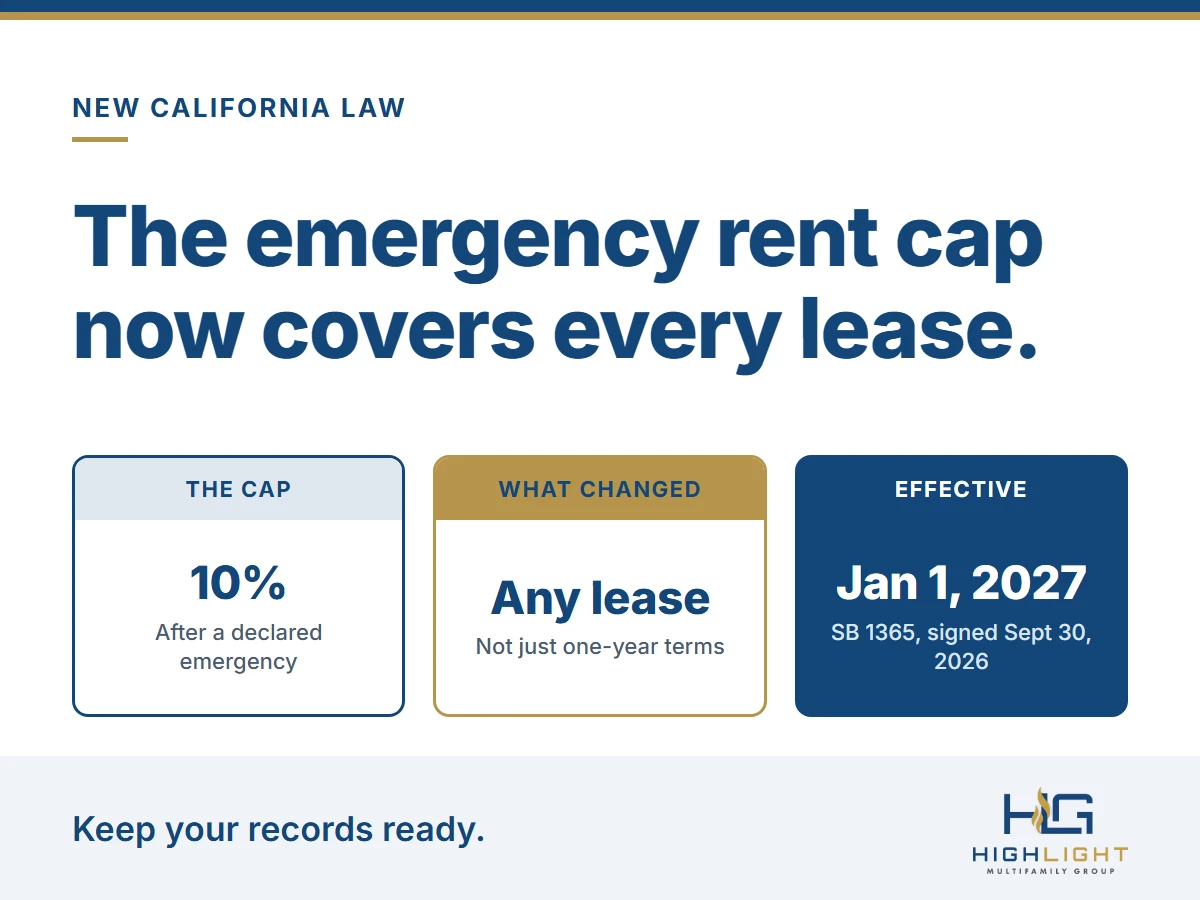
Governor Newsom signed SB 1365 on September 30, 2026. It changes the part of California’s price gouging law that limits rent increases after a declared emergency.
The 10% cap will now apply to rental housing with a lease of any length. Before, it covered only housing with an initial lease term of one year or less.
The old exceptions are now affirmative defenses. If you charge more than 10% during an emergency, you would have to prove the exception applies.
As a regular, non-urgency law, it takes effect January 1, 2027. It does not change rent control. The City’s Rent Stabilization Ordinance and AB 1482 still set their own, lower limits.
How the Emergency Rent Cap Works
California Penal Code section 396 is the state’s price gouging law. When the President or the Governor proclaims a state of emergency, or a county, city, or city and county declares a local emergency, it becomes unlawful to raise the rental price of housing by more than 10% for an existing or prospective tenant. The limit lasts for 30 days after the proclamation or declaration, or for any longer period the proclamation is extended, and local officials can extend it in steps of up to 30 days.
A violation is a misdemeanor, punishable by up to a year in county jail, a fine of up to $10,000, or both. It is also treated as an unlawful business practice, which opens the door to civil remedies on top of the criminal penalty. SB 1365 amends section 396 and does not change those penalties.
What SB 1365 Changes
Leases of any length. Under the old law, “housing” meant rental housing with an initial lease term of no longer than one year. SB 1365 defines it as any rental housing, regardless of the length of the initial lease. A long-term lease will no longer put a unit outside the cap.
Exceptions become defenses. The old statute exempted certain increases. The new statute makes them affirmative defenses, which means a landlord charged with violating the cap has to prove the facts that bring the increase within the defense.
Two defenses for rent increases. First, the tenant contractually agreed to the increase before the emergency was proclaimed. Second, the increase is directly attributable to the cost of repairs or additions beyond normal maintenance that were incurred within the year before the proclamation, and either the unit was rented, advertised, or offered for rent when the costs were incurred, or the owner can prove that, within that year, the intent to offer the unit for rent within six months of the work already existed.
A tighter daily-rate rule. For housing that was not offered at a daily rate in the year before the emergency but is afterward, the bill sets the rental price at one-thirtieth of the amount that applies to housing not offered for rent in the prior year. That mostly affects short-term rentals.
How the Rental Price Is Measured
The cap is measured from the rent the tenant actually paid. For a unit rented within the year before the emergency, the baseline is the actual rent paid. For a unit not rented but offered within that year, it is the most recent rent offered. For a unit not rented or offered at all in the prior year, the statute uses 160% of the fair market rent set by the U.S. Department of Housing and Urban Development, plus 5% if the unit is offered fully furnished.
For a unit that becomes vacant during the emergency and is covered by a local rent control ordinance, the baseline is the greater of the previous tenant’s actual rent or the HUD-based amount. The law does not let you add charges for other goods or services, such as gardening or utilities, to the baseline.
What It Does Not Change
Rent control still sets the limit. The statute says it does not authorize a landlord to charge more than a local rent control ordinance allows, so an RSO building stays under the City’s limit. For newer buildings, see our guide to the 2026 AB 1482 rent cap, which sets its own ceiling.
Lawful evictions are still allowed. The statute says it does not stop an owner from evicting a tenant for any lawful reason. It does bar evicting a residential tenant and then renting the unit to someone else at a price above what the evicted tenant could be charged under the cap, though an eviction that was lawfully begun before the proclamation can continue.
What It Means for LA Owners
Plan renewals around the calendar. If an emergency has been declared where your building is, do not assume a two-year lease or a long-term renewal puts a larger increase outside the cap after January 1, 2027.
Keep proof. To rely on either defense you need records: the tenant’s signed agreement and its date, invoices and permits that show when repair costs were incurred, and rent rolls, listings, or ads that show the unit was rented or offered for rent at the time. Organize them now, because the burden is on you.
Know your local emergencies. Both state and local declarations trigger the cap, and local officials can extend it. Check your city and county announcements, and ask your attorney or apartment association before you send any increase above 10% during a declared emergency.
Expect buyers to ask. A buyer reviewing a building that raised rents in the weeks after an emergency may ask how those increases comply. Clean records make a sale smoother. See our guides to selling with tenants under rent control and to getting ready to sell.
What About the El Niño Emergency?
On September 21, 2026, the Governor proclaimed a statewide state of emergency ahead of a forecast strong El Niño, which we describe in our El Niño checklist for apartment owners. As we note there, the California Apartment Association reported that the proclamation expressly suspends the price gouging restrictions “at this time.” SB 1365 takes effect January 1, 2027, so it does not govern what you do today. Ask your attorney how it applies if an emergency is still in effect when it begins.
Talk With Us
If you are thinking about selling, we can help you present your rent roll and records in the way buyers expect. Start with a free Broker Opinion of Value or the free property value calculator.
This article is general information, not legal advice. Please confirm how SB 1365 applies to your property with an attorney.
Sources
Frequently Asked Questions
What is SB 1365?
A California law signed on September 30, 2026 that amends the state’s price gouging statute, Penal Code section 396. It applies the 10% emergency rent cap to rental housing regardless of the length of the lease, and it turns the old exceptions into defenses the landlord must prove.
When does SB 1365 take effect?
January 1, 2027. It is a regular, non-urgency statute. Ask your attorney how it applies if an emergency is already in effect when it begins.
How long does the emergency rent cap last?
For 30 days after a state or local emergency is proclaimed or declared, or any longer period the proclamation is extended. Local officials can extend the limit in steps of up to 30 days each.
Does SB 1365 replace Los Angeles rent control or AB 1482?
No. The statute says it does not authorize a landlord to charge more than a local rent control ordinance allows. Rent-stabilized buildings stay under the City’s limit, and newer buildings stay under the AB 1482 cap.
What can I use as a defense if I raised rent more than 10% during an emergency?
Two are listed: the tenant contractually agreed to the increase before the emergency was proclaimed, or the increase is directly attributable to repairs or additions beyond normal maintenance incurred in the prior year, if the unit was rented or offered for rent at the time or the intent to offer it within six months already existed. You would have to prove the facts.
What are the penalties for violating the emergency rent cap?
A violation is a misdemeanor punishable by up to a year in county jail, a fine of up to $10,000, or both, and it is also treated as an unlawful business practice. Talk to an attorney before raising rent by more than 10% during a declared emergency.