
AB 1482's Rent Cap Just Reset: What It Means for Post-1978 LA Apartment Buildings
Q3 2026
What AB 1482 Actually Caps
Assembly Bill 1482, California's statewide Tenant Protection Act, has capped most residential rent increases since 2020 at whichever is lower: 10%, or 5% plus the percentage change in the regional Consumer Price Index (CPI) over the prior year. That CPI figure is not fixed. It is recalculated each year, region by region, which means the actual dollar ceiling on a rent increase moves annually even though the law itself has not changed.
Why This Matters Specifically for Post-1978 LA Buildings
Los Angeles' own Rent Stabilization Ordinance (RSO) covers apartment buildings with a certificate of occupancy issued before October 1, 1978, and sets its own, generally lower annual increase limit. Buildings built on or after that date typically fall outside the local RSO entirely.
For those non-RSO buildings, once they age past AB 1482's own 15-year exemption for new construction, the statewide AB 1482 formula, not the city's ordinance, is what actually limits how much you can raise rent each year. For a large share of LA's post-1978 apartment stock, this CPI-based number is the real ceiling owners are working within.
The New Maximum, Effective August 1, 2026
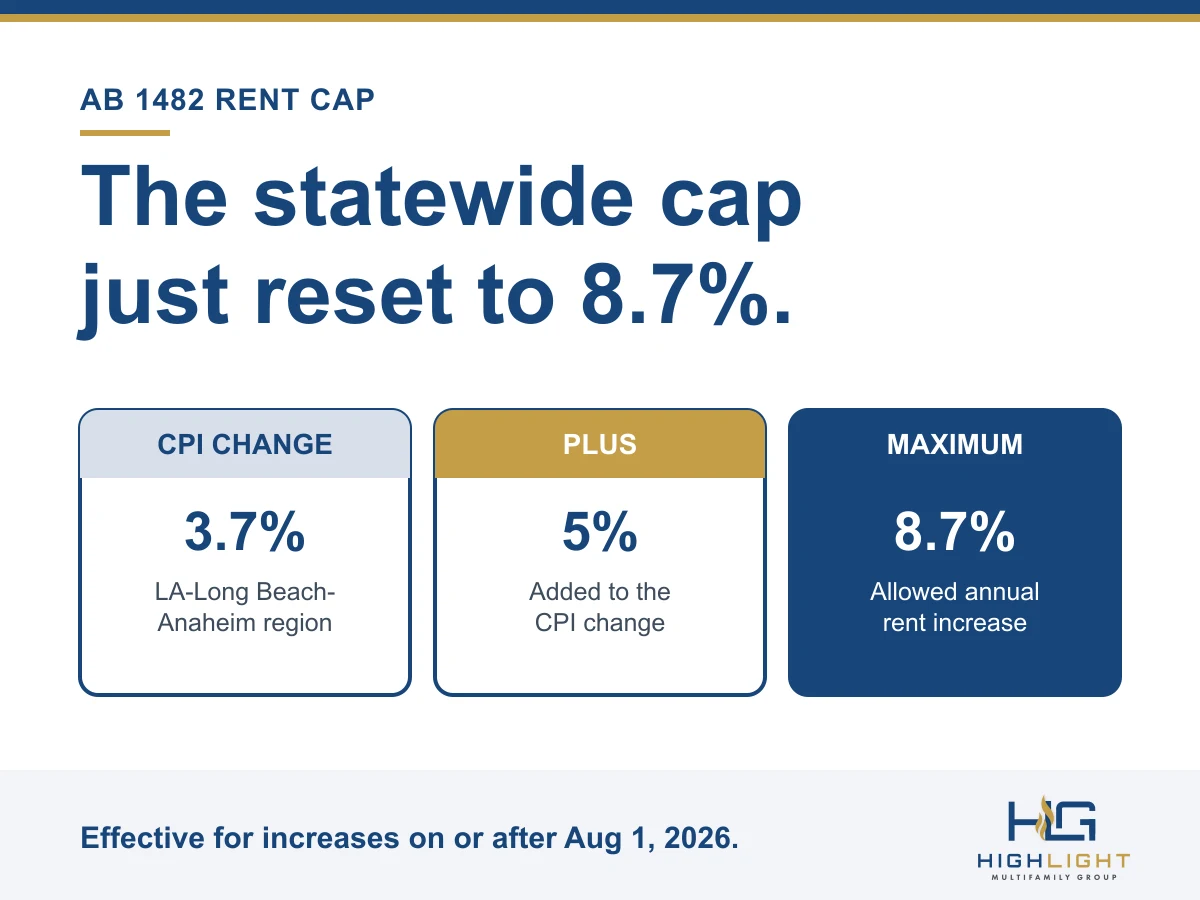
For increases effective on or after August 1, 2026, the Los Angeles-Long Beach-Anaheim region’s CPI change came in at 3.7%, putting the maximum allowable increase at 8.7%, the CPI change plus 5%. That is up from the prior year’s cap of 8.0% (3.0% CPI plus 5%).
| Region | CPI Change | 5% + CPI Maximum |
|---|---|---|
| Western Region | 3.5% | 8.5% |
| California | 3.6% | 8.6% |
| Los Angeles-Long Beach-Anaheim | 3.7% | 8.7% |
| San Francisco-Oakland-Hayward | 3.8% | 8.8% |
| San Diego-Carlsbad | 3.2% | 8.2% |
| Riverside-San Bernardino-Ontario | 3.1% | 8.1% |
Source: Apartment Association of Greater Los Angeles (AAGLA), citing U.S. Bureau of Labor Statistics and the CA Department of Industrial Relations. Figures shown are the CPI change over the most recent 12-month period and the resulting AB 1482 cap (5% + CPI, subject to a 10% overall ceiling), effective for increases on or after August 1, 2026.
Which Number Applies, and When
Under the Tenant Relief Act amendment, the CPI figure that applies depends on the increase’s effective date. An increase effective before August 1, 2026 uses the prior year’s CPI change (3.0% for the LA-Long Beach-Anaheim region, an 8.0% maximum). An increase effective on or after August 1, 2026 uses the new figure (3.7%, an 8.7% maximum). All percentages are rounded to the nearest tenth of a point.
These figures come from the Apartment Association of Greater Los Angeles (AAGLA), citing the U.S. Bureau of Labor Statistics and the California Department of Industrial Relations, and they are updated on this same cycle every year.
Why This Matters When You Are Buying or Selling
For a buyer underwriting a non-RSO, value-add deal, the AB 1482 cap is a real, legal ceiling on how quickly in-place rents can be brought to market, and it is worth confirming against the actual current figure rather than a remembered number from a prior year.
For an owner deciding whether and when to push a rent increase, knowing the precise, current cap avoids both leaving money on the table and inadvertently exceeding a limit that moves every year on the same August 1 cycle.
This is general market information, not legal advice. Confirm the applicable cap and its exact application to your property with your attorney or property manager before implementing any increase.
Frequently Asked Questions
How much can I raise rent in Los Angeles in 2026?
For increases effective on or after August 1, 2026, the Los Angeles-Long Beach-Anaheim region’s CPI change came in at 3.7%, putting the maximum allowable increase at 8.7%, which is the CPI change plus 5%. That is up from the prior year’s cap of 8.0% (3.0% CPI plus 5%).
How is the California rent cap (AB 1482) calculated?
AB 1482, California’s statewide Tenant Protection Act, has capped most residential rent increases since 2020 at whichever is lower: 10%, or 5% plus the percentage change in the regional Consumer Price Index (CPI) over the prior year. The CPI figure is recalculated each year, region by region, so the actual ceiling moves annually even though the law has not changed.
Does my LA apartment building have rent control, and does the AB 1482 rent cap apply to it?
Los Angeles’ Rent Stabilization Ordinance (RSO) covers buildings with a certificate of occupancy issued before October 1, 1978, and sets its own, generally lower annual increase limit. Buildings built on or after that date typically fall outside the RSO, and once they age past AB 1482’s own 15-year exemption for new construction, the statewide formula is what limits how much rent can rise each year.
Which rent cap applies if I raise rent before or after August 1, 2026?
It depends on the increase’s effective date. An increase effective before August 1, 2026 uses the prior year’s CPI change (3.0%, an 8.0% maximum). An increase effective on or after August 1, 2026 uses the new figure (3.7%, an 8.7% maximum). All percentages are rounded to the nearest tenth of a point.
Where does the 8.7% rent cap number come from, and when does it change?
They come from the Apartment Association of Greater Los Angeles, citing the U.S. Bureau of Labor Statistics and the California Department of Industrial Relations, and they are updated on the same August 1 cycle every year. Confirm the applicable cap and how it applies to your property with your attorney or property manager before implementing any increase.
How does the rent cap affect what my apartment building is worth when I sell or buy?
For a buyer underwriting a non-RSO, value-add deal, the cap is a real, legal ceiling on how quickly in-place rents can be brought to market, so it is worth checking against the current figure rather than a remembered number from a prior year. For an owner deciding when to raise rents, knowing the exact cap avoids both leaving money on the table and exceeding a limit that moves every year. See also selling with tenants under rent control.