
Selling Near a Measure ULA Threshold? Why Price and Timing Matter
Q4 2026
What Changed on July 1, 2026
Measure ULA is the City of Los Angeles transfer tax, often called the mansion tax, on property sales above a set price. Its price thresholds are adjusted for inflation every year, and the latest adjustment applies to sales closing after June 30, 2026. The thresholds are now $5.4 million and $10.9 million, up from $5.3 million and $10.6 million a year earlier.
Sales above $5.4 million but below $10.9 million pay a 4% ULA tax. Sales at $10.9 million or more pay 5.5%. The tax applies only to property inside the City of Los Angeles, and it is in addition to the City’s regular transfer tax of 0.45%.
Why a Price Just Over the Line Costs So Much
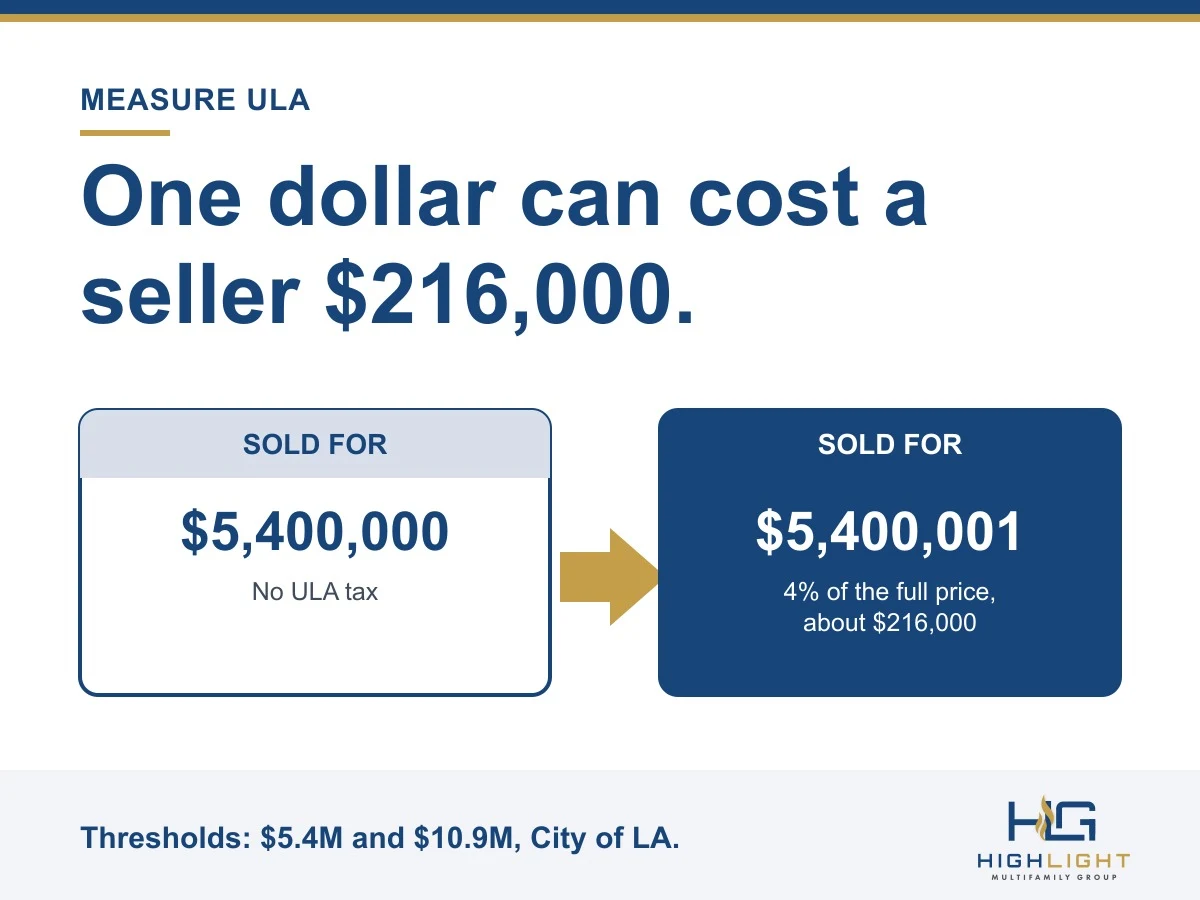
The key detail is that the tax is not marginal. The ULA tax applies to the entire sale price, not only the portion above the threshold. A building that sells for $5,400,000 owes no ULA tax. A building that sells for $5,400,001 owes 4% of the full price, about $216,000.
| Sale Price | ULA Rate | ULA Tax | Left After ULA |
|---|---|---|---|
| $5,400,000At the lower threshold | None | $0 | $5,400,000 |
| $5,500,000Just over it | 4% | $220,000 | $5,280,000 |
| $5,625,000Break-even with $5.4M | 4% | $225,000 | $5,400,000 |
| $10,800,000Just under the upper threshold | 4% | $432,000 | $10,368,000 |
| $10,900,000At the upper threshold | 5.5% | $599,500 | $10,300,500 |
| $10,975,000About break-even with $10.8M | 5.5% | $603,625 | $10,371,375 |
Illustration only. Shows the ULA tax alone, before the City’s regular transfer tax, commissions, and other closing costs. Rates and thresholds from the City of Los Angeles Office of Finance.
The Dead Zone Above Each Threshold
That creates a stretch of prices where a higher number puts less money in your pocket. At $5.5 million, a seller keeps $120,000 less after ULA than at $5.4 million, and it takes a price of about $5.625 million to net the same. The pattern repeats at the upper line: a sale at $10.9 million leaves about $67,500 less than a sale at $10.8 million, and the price has to reach roughly $10.97 million to catch up.
The figures above are before commissions, the regular transfer tax, and other closing costs, so your actual numbers will differ, but the shape of the problem does not. Also keep in mind that the tax is calculated on the gross value of the sale, including any loan the buyer assumes, so assuming debt does not lower the taxable amount.
What Sellers Near a Threshold Can Do
If your building is priced near either number, a few things are worth weighing before you list.
Price with the threshold in mind. Sometimes a modest price adjustment leaves you with more money than a higher price that crosses the line. We model your net proceeds at several price points before you list, not after you are under contract.
Watch the calendar. The thresholds are adjusted each year for inflation, so a building priced just above a line today may fall under it after the next adjustment. If you are close, ask us how your closing date interacts with the adjustment.
Do not count on a 1031 exchange to reduce the tax. A 1031 exchange can defer your capital gains tax, but it does not exempt a sale from Measure ULA, and exchanges are not among the exemptions the City lists. The tax is calculated on the sale of your building either way. An exchange is still a powerful tool for the gain, and you can read more in our guide to 1031 exchanges, but it solves a different problem.
Know who the buyer is. In narrow cases the buyer matters. Sales to certain qualified affordable housing nonprofits and to government agencies are exempt from ULA, and the exemption for qualified affordable housing organizations has to be requested through the Los Angeles Housing Department. For most private sales it will not apply, but it is worth asking.
Own a Building in West Hollywood or Santa Monica?
Measure ULA stops at the City of Los Angeles line. West Hollywood is a separate city, so ULA does not apply there, and West Hollywood has no city transfer tax of its own. See our West Hollywood multifamily page for a side-by-side example. Santa Monica is also exempt from ULA but has its own version, Measure GS, which takes 5.6% of the full price at $8 million and up. Our Santa Monica page shows how that line works.
Where Things Stand Today
There has been a lot of talk about changing Measure ULA, but as of this writing in October 2026, the rates and thresholds above are the current rules. In July, the Los Angeles City Council shelved a proposal to put an exemption for new multifamily construction on the November ballot, so that measure will not go before voters this fall. Rules like this can change, so we confirm the current thresholds and exemptions with the City’s Office of Finance before we price any building near a line.
Run the Numbers Before You List
If your building could land near $5.4 million or $10.9 million, the time to look at the math is before you set a price. Try our Measure ULA calculator to see your transfer taxes and net proceeds at any price, start with our free property value calculator for a quick range, then request a free Broker Opinion of Value and we will show you what you would net at different prices and closing dates. If you are deciding whether to sell at all, read our guide to holding or selling under Measure ULA.
Planning around year-end? Our article on timing a sale before December 31 covers how closing dates affect your taxes.
This article is general information, not tax or legal advice. Please confirm how Measure ULA applies to your sale with your CPA or tax attorney.
Sources
City of Los Angeles Office of Finance: Real Property Transfer Tax and Measure ULA FAQ
Apartment Association of Greater Los Angeles: Measure ULA update on the July 2025 thresholds
Bisnow: LA City Council kills ballot measure for ULA multifamily exemption
Frequently Asked Questions
What is the LA mansion tax (Measure ULA) in 2026, and at what price does it start?
The thresholds are $5.4 million and $10.9 million for sales closing after June 30, 2026, up from $5.3 million and $10.6 million a year earlier. Sales above $5.4 million but below $10.9 million pay a 4% ULA tax, and sales at $10.9 million or more pay 5.5%, in addition to the City’s regular transfer tax of 0.45%.
Does the LA mansion tax apply to the whole sale price or just the part above $5.4 million?
The whole price. The tax is not marginal. A building that sells for $5,400,000 owes no ULA tax, but one that sells for $5,400,001 owes 4% of the full price, about $216,000.
Can I avoid the LA mansion tax (Measure ULA) with a 1031 exchange?
No. A 1031 exchange can defer your capital gains tax, but it does not exempt a sale from Measure ULA, and exchanges are not among the exemptions the City lists. The tax is calculated on the sale of your building either way. See our 1031 exchange guide for what an exchange does cover.
Do I pay Measure ULA if my building is in West Hollywood or Santa Monica?
No. Measure ULA applies only inside the City of Los Angeles. West Hollywood is a separate city, so ULA does not apply there, and West Hollywood has no city transfer tax of its own. Santa Monica is also exempt from ULA but has its own version, Measure GS, which takes 5.6% of the full price at $8 million and up. See our West Hollywood and Santa Monica pages.
Is anyone exempt from the LA mansion tax (Measure ULA)?
In narrow cases. Sales to certain qualified affordable housing nonprofits and to government agencies are exempt, and the exemption for qualified affordable housing organizations has to be requested through the Los Angeles Housing Department. For most private sales it will not apply.
What should I do if my building is priced right around $5.4 million?
Price with the threshold in mind, since a modest price adjustment can leave you with more money than a higher price that crosses the line. Watch the calendar, because the thresholds adjust each year for inflation, and run the numbers before you list. A free Broker Opinion of Value can show what you would net at different prices and closing dates.