
Measure ULA: Should You Hold or Sell Your LA Apartment Building?
Q4 2026
Key Takeaways
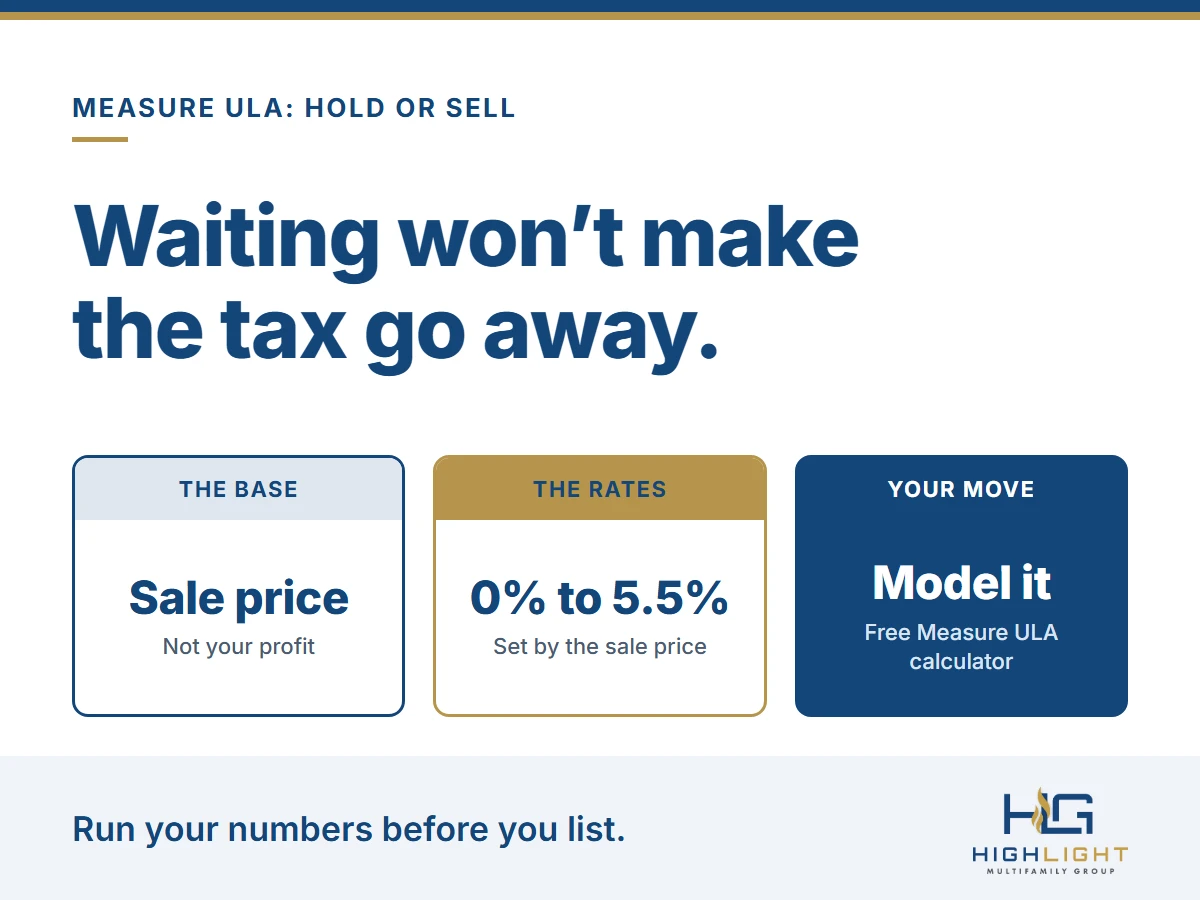
Measure ULA is charged on the sale price, not on your gain. It is owed whether you made money on the building or lost it.
Waiting does not make the tax go away. It is a cost of selling at any time, so for most owners it affects when and at what price they sell more than whether they sell.
The tax matters most when a price lands near $5.4 million or $10.9 million. Between those lines, a few percent on the whole price can cost more than a year of the building’s income.
Decide on your goals first, then model the tax. Our free Measure ULA calculator shows what you would keep at any price.
Why Measure ULA Is a Hold-or-Sell Question
Most taxes on a sale depend on how much you gained. Measure ULA does not. The City of Los Angeles charges it on the value of the property being sold, and for closings after June 30, 2026 the rate is 0% at or below $5.4 million, 4% above $5.4 million and under $10.9 million, and 5.5% at $10.9 million or more. The rate applies to the entire price. If you want the mechanics, start with our Measure ULA guide.
Because it is a flat percentage of the price, it hits an owner with a low basis and an owner with a high basis equally. That is why it changes how owners think about holding: for a building above the first line, a sale carries a large, certain cost that has nothing to do with how well the building has performed.
What the Tax Costs at Different Prices
At $5,400,000 the ULA tax is zero. At $5,400,001 it is 4% of the full price, about $216,000.
At $6,000,000 the ULA tax is $240,000. The City’s regular transfer tax of 0.45% adds $27,000, and the LA County tax of $1.10 per $1,000 adds $6,600, for $273,600 in transfer taxes in all, or 4.56% of the price.
At $12,000,000 the ULA tax is $660,000. With the regular City and County taxes, transfer taxes total $727,200, or 6.06% of the price.
These figures are before the broker’s commission, other closing costs, and your income taxes. You can run your own price through the Measure ULA calculator.
The Tax in Terms of Income
A useful way to judge the tax is to compare it with what the building earns. Suppose a building sells for $6,000,000 at a 5.5% cap rate. Its net operating income is about $330,000 a year. The $240,000 ULA tax is about 8.7 months of that income, paid once, on the day you sell.
That framing does not tell you whether to sell. It tells you what the exit costs, so you can weigh it against the other things on the scale: the income you keep earning if you hold, the repairs and compliance work coming up, and what you plan to do with the proceeds.
Reasons Owners Choose to Hold
The income continues. Every year you hold, you keep collecting the building’s net operating income, and the tax is not due until you sell.
The thresholds move up. The City adjusts both lines every year for inflation, so a building that sits just over a line today could be under it after a future adjustment, if its value does not rise faster. We confirm the current figures with the City before pricing, because they change each July.
A planned handoff. Some owners intend to pass the building to family. That does not avoid ULA, since a later sale above a line would owe it too, but an heir’s income tax on a sale soon after inheriting is often small because of the stepped-up basis rule. Ask your CPA and attorney how it applies to you. Our guide to inherited apartment buildings covers the basics.
Reasons Owners Sell Anyway
The tax is real, but it is only one side of the decision. Owners still sell above the lines for reasons that have nothing to do with ULA. They may be ready to stop managing, face costly repairs or compliance work, want to move capital out of one building into several, or be concerned about how much of their wealth sits in a single property.
It also helps to remember that waiting does not remove the tax. If you will sell eventually, and the building will still be above a line then, the tax is part of the exit either way. It is worth modeling now, but it should not trap you into holding a building that no longer fits your plans. A 1031 exchange can defer your capital gains tax, but it does not exempt a sale from Measure ULA.
Questions to Ask Before You Decide
What would I net at today’s price, and at a price just under the nearest line? Run both in the calculator.
What does the building earn after expenses, and what repairs or compliance costs are coming?
What will I do with the money, and how does that compare with what the building earns now?
Is my price close enough to a line that a modest price change would leave me with more? If so, a Broker Opinion of Value can show your net at several prices.
Which tax advisor and attorney will confirm how ULA and my income taxes apply before I list?
If Your Building Is Near a Line
A building priced just over $5.4 million or $10.9 million is in a stretch where a higher price can put less money in your pocket, which we describe in our guide to the dead zone above each threshold. The calculator flags it and shows the price you would need to reach to come out even. If your building sits in that range, the decision is not only hold versus sell. It is also what price to sell at.
Be careful with any plan to restructure a sale to avoid the tax. The City reviews payments through its own compliance process, and it will invoice the difference if it finds an underpayment. Take any such idea to a tax attorney first.
Not in the City of Los Angeles?
Measure ULA stops at the City of Los Angeles line. Buildings in West Hollywood and Beverly Hills owe no city transfer tax, and Santa Monica has its own tax, Measure GS, at $8 million and up. The calculator covers all of these.
Talk With Us
If you are weighing a sale and your building could land near a line, start with the Measure ULA calculator, then request a free Broker Opinion of Value. We will show you what you would net at different prices and closing dates, and whether holding makes sense for you.
This article is general information, not tax or legal advice. Please confirm how Measure ULA applies to your sale with your CPA or tax attorney.
Sources
City of Los Angeles Office of Finance: Real Property Transfer Tax and Measure ULA FAQ
Frequently Asked Questions
Does Measure ULA make it better to hold my apartment building instead of selling?
Not by itself. The tax is owed whenever you sell above the first threshold, so holding does not remove it. It affects when and at what price you sell more than whether you sell. Decide on your goals, then model the tax in our Measure ULA calculator.
Is Measure ULA charged on my profit or on the sale price?
On the sale price. The City charges it on the value of the property sold, so it applies whether you made a large gain or none. For closings after June 30, 2026, the rate is 0% at or below $5.4 million, 4% above $5.4 million and under $10.9 million, and 5.5% at $10.9 million or more.
How much is the Measure ULA tax on a $6 million apartment building?
The ULA tax is $240,000, which is 4% of $6,000,000. With the City’s regular transfer tax of 0.45% ($27,000) and the LA County tax of $1.10 per $1,000 ($6,600), transfer taxes total $273,600. These figures are before commissions and income taxes.
Can I wait for Measure ULA to be repealed or changed?
You can, but a decision that depends on a rule change that has not happened is a risk. The rates and thresholds in this article are the current rules. Confirm them with the City of Los Angeles Office of Finance before you price a building near a line.
Does a 1031 exchange avoid Measure ULA?
No. A 1031 exchange can defer your capital gains tax, but it does not exempt a sale from Measure ULA. See our 1031 exchange guide for what an exchange does cover.
How do I find out what I would keep after Measure ULA at different prices?
Use our Measure ULA calculator for transfer taxes and net proceeds at any price, and request a free Broker Opinion of Value to see the numbers on your actual building.