
Inherited an Apartment Building in Los Angeles? What to Do First
Q4 2026
Key Takeaways
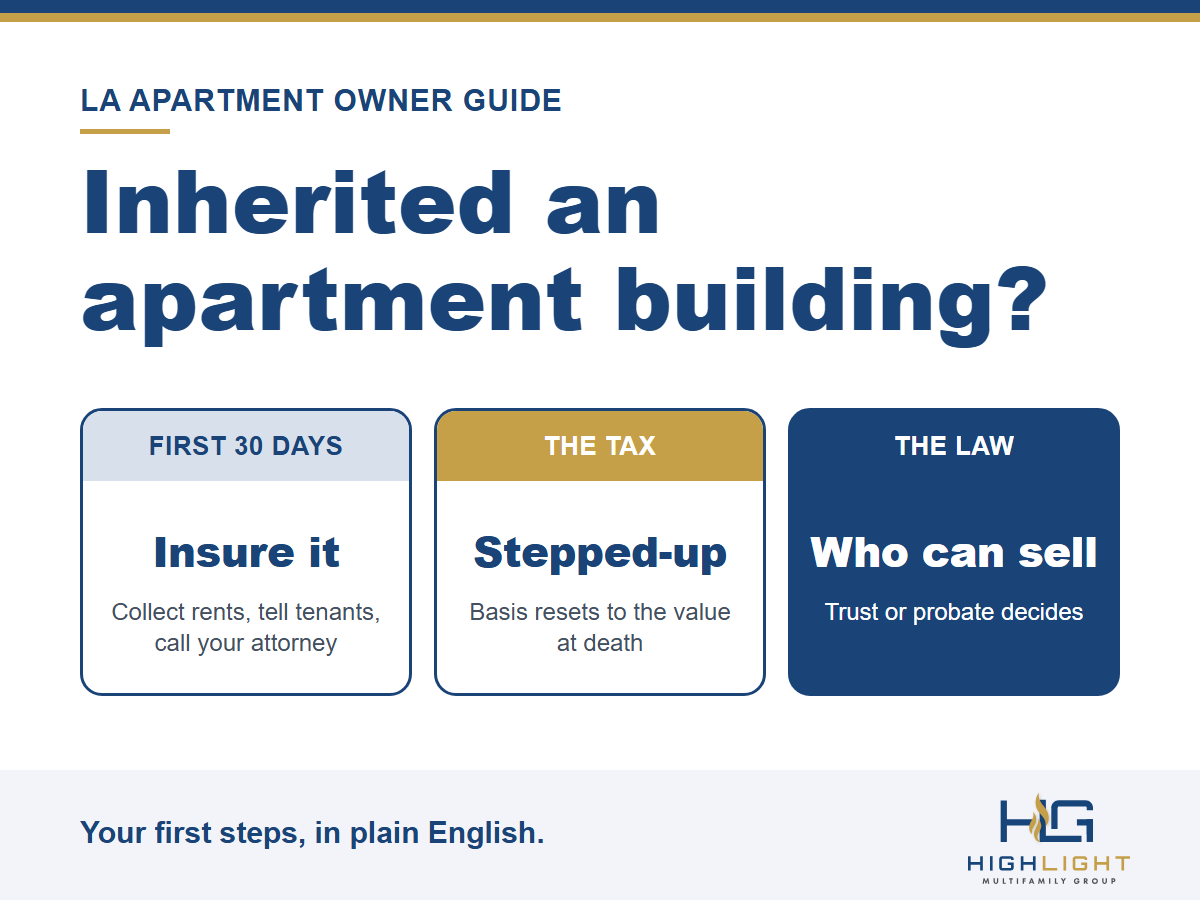
Inheriting an apartment building comes with decisions that cannot wait: the tenants, the rents, the insurance, and the bills do not pause. Take care of those first, then give yourself time to decide whether to keep or sell.
Who can sell depends on how title was held. A successor trustee can usually act under the trust’s terms. If the building was not in a trust, it generally goes through probate, and the court process shapes the sale.
The tax picture is often kinder than heirs expect on a sale, because an heir’s tax basis generally resets to the building’s value at the date of death. Keeping the building is different: California reassesses property tax at market value, and Proposition 19 does not protect an inherited rental property.
Bring in a probate or trust attorney and a CPA early. We work alongside them, and we can give you a free, confidential opinion of what the building is worth.
Your First 30 Days
The building keeps running while the paperwork catches up. Rent is due, repairs come up, and the bills and taxes continue. These steps protect the building, the tenants, and the family.
Confirm the insurance. Check that the building’s insurance is in force, and tell the insurer about the owner’s death. A gap in coverage on an occupied building is a risk nobody wants.
Keep the money separate. Rents belong to the estate or trust, so they should go into an account set up for it, not a personal account. Your attorney will tell you how.
Tell the tenants who to pay and who to call. Tenants mostly want to know that their lease and their rent stay the same, and in a sale of an occupied building they generally do. Our guide to selling with tenants under rent control explains how leases carry over.
Gather the documents. You will need the death certificate, the trust or will, the leases, the current rent roll, the building’s Rent Stabilization Ordinance registration if it is in the City of Los Angeles, insurance and property tax bills, and the last two years of income and expenses.
Call an attorney and a CPA. A probate or trust attorney confirms who has the authority to act, and a CPA looks at the tax side. Both should be involved before anyone lists the building.
Trust or Probate: Who Can Sell?
If the building was held in a living trust, the successor trustee generally has the authority to sell, following the trust’s terms. A trust sale usually does not need a court’s approval.
If the building was not in a trust, it generally goes through probate. An apartment building is worth many times California’s small-estate limit, which is about $200,000, so the simplified process for small estates will not apply. The court appoints an executor or administrator, and that person, not the heirs directly, handles the sale.
How much the court is involved depends on the authority it grants. With full authority under California’s Independent Administration of Estates Act, an executor can generally sell after giving the heirs notice of the proposed sale, and the court steps in only if someone objects. With limited authority, the sale usually goes to the court for confirmation, and at that hearing other buyers can offer more than the accepted price. Your probate attorney will tell you which applies.
That is why the legal question comes before the pricing question. A buyer wants to know the seller can deliver clear title and a closing date, and a broker who understands the process can build the timeline around it. Our page on trust and estate sales explains how we work with trustees and executors.
What Tax Will You Owe if You Sell?
Most heirs worry about capital gains tax. The usual answer is better than they fear. Under IRS rules, the basis of inherited property is generally its fair market value on the date of the owner’s death, or on an alternate valuation date if the executor chooses one. That resets the starting point for figuring gain, so a building sold soon after the death typically produces little or no taxable gain, and the previous owner’s depreciation history generally does not carry over. Our guide to capital gains and depreciation recapture explains the pieces.
That makes the date-of-death value important. A formal appraisal is the usual way to support it, and a Broker Opinion of Value is not an appraisal. We explain the difference in our article on Broker Opinion of Value vs. appraisal.
Federal estate tax is a separate tax on the estate, not on the heir, and it applies only to large estates. For people who die in 2026, the federal exemption is $15 million per person. California does not have its own estate or inheritance tax.
If the estate sells the building, the usual transfer taxes apply to the sale, including Measure ULA above $5.4 million inside the City of Los Angeles. Ask the escrow officer whether any exemption applies to your situation, and see our Measure ULA guide for how the thresholds work.
If You Keep It: Property Tax
Keeping an inherited building has its own tax effect. In California, a change in ownership triggers a reassessment, so the building’s assessed value resets to market value. For a building owned for decades, that can raise the yearly property tax bill sharply.
Proposition 19 limits the old parent-child exclusion to a family home that was the parent’s principal residence and becomes the child’s principal residence, and to family farms. The Board of Equalization says a transfer of a rental property between parents and children does not qualify for the exclusion. So an inherited apartment building is generally reassessed.
The county assessor must also be told about the death. A change in ownership statement for the death of a property owner (form BOE-502-D) is due within 150 days of the date of death, and late filing can bring penalties. The executor or trustee normally files it, with the attorney’s help.
Keep It or Sell It?
There is no right answer, only the one that fits your family. A few questions help. Does anyone want to manage the building, and do they know what it takes? Can the heirs agree on a plan? What would the property tax bill be after reassessment? What repairs are coming? And what would the sale proceeds do for the family compared with the building’s income?
Our guide to whether to sell an apartment building walks through seven questions worth answering first. If the heirs want to sell, they can list the building openly or sell it quietly to a limited group of buyers. Our article on selling off-market vs. listing openly explains the tradeoffs, including why privacy matters to many families.
How We Sell Inherited Buildings
Buildings that come through an estate are often older, with deferred maintenance and rents that have not moved in years. That is common, and it is not a barrier to a sale. We price these buildings honestly, from the rent roll and comparable sales, and we bring them to buyers who know what they are taking on, so the family is not asked to fix decades of deferred decisions first.
We work with the trustee or executor, the attorney, and the CPA so the sale fits the legal timeline. A typical Los Angeles apartment sale takes 60 to 90 days from listing to closing, and a sale that needs court confirmation adds a step. Our step-by-step guide to selling shows each stage.
Mistakes We Would Help You Avoid
Waiting without a plan. Insurance, taxes, and repairs continue every month, whether or not anyone has decided what to do.
Pricing from sentiment. A building’s value is set by its income and by what buyers are paying, not by what it meant to the family.
Skipping the date-of-death value. A formal appraisal supports the tax basis. Ask your CPA whether you need one.
Assuming Proposition 19 will keep the property tax low. For a rental building, it generally will not.
Leaving tenants in the dark. A short, honest note about who to pay and who to call prevents most problems.
Talk With Us
We guide families, trustees, and executors through these sales at their pace. Start with a free, confidential Broker Opinion of Value, or read more on our trust and estate sales page.
This article is general information, not legal or tax advice. Probate and tax rules are detailed and change, so please confirm the details with a California probate or trust attorney and a CPA.
Sources
IRS Publication 551: Basis of Assets
California Board of Equalization: Proposition 19
Frequently Asked Questions
I inherited an apartment building in Los Angeles. What do I do first?
Protect the building and the tenants first: confirm the insurance is in force, keep the rents in an account for the estate or trust, tell tenants who to pay, and gather the documents. Then talk to a probate or trust attorney and a CPA before you decide whether to keep or sell.
Do I have to go through probate to sell an inherited apartment building in California?
It depends on how the building was owned. If it was in a living trust, the successor trustee can generally sell under the trust’s terms without probate. If it was not, it generally goes through probate, because an apartment building is worth far more than California’s small-estate limit of about $200,000.
Do I pay capital gains tax if I sell an apartment building I inherited?
Often very little. Under IRS rules, an heir’s basis in inherited property is generally its fair market value on the date of death, so a sale soon afterward typically produces little or no taxable gain. Confirm with your CPA, and keep documentation of the date-of-death value. See our guide to capital gains and depreciation recapture.
Will my property taxes go up if I keep an inherited apartment building in California?
Usually, yes. A change in ownership triggers a reassessment to market value. Proposition 19 limits the parent-child exclusion to a family home that becomes the child’s principal residence, and the Board of Equalization says a transfer of a rental property between parents and children does not qualify.
How long does it take to sell an inherited apartment building?
A typical Los Angeles apartment sale takes 60 to 90 days from listing to closing. A probate sale that needs court confirmation adds a step, and sorting out who has authority comes first, so ask your attorney for a timeline before you list.
Do I need an appraisal when I inherit an apartment building?
For tax purposes, a date-of-death value supports your basis, and a formal appraisal is the usual way to document it, so ask your CPA. A Broker Opinion of Value is not an appraisal, but it is a free, confidential way to see what buyers would likely pay. See Broker Opinion of Value vs. appraisal.
Is there an estate tax in California?
California does not have its own estate or inheritance tax. The federal estate tax applies only to large estates: for people who die in 2026, the exemption is $15 million per person.
Can I sell an inherited apartment building with tenants in it?
Yes. Most Los Angeles apartment buildings sell with tenants in place. Leases and rent rules stay with the building, so the buyer steps into the owner’s position. See our guide to selling with tenants under rent control.
My parent died and left me an apartment building. What should I do?
Take a breath, then handle the urgent items: make sure the insurance is active, keep collecting rent into an account for the estate or trust, tell the tenants who to pay and who to call, and find the trust or will. Call a probate or trust attorney and a CPA before you sign anything or list the building. You do not have to decide whether to keep or sell in the first month.
Who collects the rent and pays the bills after the owner of an apartment building dies?
If the building was in a trust, the successor trustee generally takes over. If it was not, the court appoints an executor or administrator in probate, and that person manages the building until it is sold or distributed. Until then, rent should go into an account for the estate or trust, and the mortgage, insurance, property taxes, and repairs still have to be paid. Your attorney can tell you who has the authority to act.
What happens to the mortgage on an inherited apartment building?
The loan does not go away when the owner dies. Payments, taxes, and insurance have to stay current while the estate or trust decides what to do. Contact the lender, and ask your attorney whether the lender can require the loan to be paid off. If you sell, the loan is paid from the sale proceeds at closing.
Can I sell an inherited duplex, triplex, or fourplex?
Yes. Heirs, trustees, and executors sell small apartment buildings all the time. The same rules apply as for a larger building: who can sell depends on whether the property was in a trust or goes through probate, and the sale follows that legal timeline. See our guide to selling a fourplex or small apartment building.
Can I sell an inherited rental property before probate is finished?
Sometimes. In probate, the executor or administrator can sell once the court has given them the authority to do so, and with limited authority the sale usually goes to the court for confirmation. A trust sale usually does not need a court. Your probate attorney will tell you when the property can be listed and when it can close.
What is the stepped-up basis on an inherited apartment building?
It is the IRS rule that an heir’s tax basis in inherited property is generally its fair market value on the date of the owner’s death, not what the owner originally paid. It resets the starting point for figuring gain, which is why a sale soon after inheriting often produces little or no taxable gain. The previous owner’s depreciation history generally does not carry over. Ask your CPA how it applies, and keep documentation of the date-of-death value.
Do I owe capital gains tax or depreciation recapture on an inherited rental property?
Usually little or none if you sell soon after the date of death, because the basis steps up to market value at that date and the previous owner’s depreciation generally does not carry over. Gain can appear later if the building rises in value after the date of death, or if you depreciate it yourself while you keep it. See capital gains and depreciation recapture, and confirm with your CPA.
Does Proposition 19 or Proposition 58 let me keep my parent’s low property tax on an inherited apartment building?
Generally no. Proposition 19 limits the parent-child exclusion to a family home that is the principal residence of both the parent and the child, and to family farms, and the Board of Equalization says a rental property transferred between parents and children does not qualify. The older Proposition 58 exclusion for other real property, up to $1 million of value, was eliminated for transfers on or after February 16, 2021. Expect the building to be reassessed to market value.
Do I have to tell the county when the owner of a property dies?
Yes. A change in ownership statement for the death of a property owner (form BOE-502-D) is due to the county within 150 days of the date of death, and late filing can bring penalties. The executor or trustee normally files it, with the attorney’s help.
Can I raise the rent on tenants after I inherit an apartment building?
The owner’s death does not cancel the tenants’ leases or the city’s rent rules. In the City of Los Angeles, rent increases on a building covered by the Rent Stabilization Ordinance stay limited, and many other California buildings are covered by the statewide cap described in our AB 1482 guide. Check the specifics with your attorney before sending any notice.
What if my brothers and sisters disagree about keeping or selling the inherited building?
It happens often. If the building is in a trust, the trustee follows the trust’s terms. If it goes through probate, the executor handles the sale under the court’s supervision. If heirs end up co-owners and cannot agree, a real estate or probate attorney can explain the options, which can include a buyout or a court-ordered sale. A neutral number from a free Broker Opinion of Value gives everyone the same starting point.
How do I find out what my inherited apartment building is worth?
Start with a free, confidential Broker Opinion of Value, which shows what buyers would likely pay based on the rent roll, expenses, and recent comparable sales. For tax purposes you may also need a formal appraisal as of the date of death, so ask your CPA. See how buyers value an apartment building.
Should I sell or keep an inherited apartment building?
There is no single right answer. Ask who will manage the building and whether they know what it takes, whether the heirs agree, what the property tax will be after reassessment, what repairs are coming, and what the sale proceeds would do for the family compared with the building’s income. Our guide to whether to sell an apartment building walks through the questions.
Can I do a 1031 exchange on an inherited property?
Often there is little reason to, because the stepped-up basis already reduces the gain on a sale soon after the date of death. If the building has gained value since then, or you want to stay invested in real estate, ask your CPA whether an exchange fits your situation. See our page on 1031 exchanges.
How long does probate take in California when the estate includes an apartment building?
It varies and often takes many months, sometimes a year or more, depending on the court, creditor claim deadlines, and whether anyone contests. Your attorney can give a realistic timeline for your case. A building held in a living trust generally avoids probate.
Is rental income from an inherited building taxable?
Generally yes. Rent collected is income, first to the estate or trust and then to the heirs once it is distributed, with the building’s expenses deducted. Your CPA will set up the reporting and tell you which return applies.
Do I need a lawyer to sell an inherited apartment building?
In practice, yes. A probate or trust attorney confirms who has the authority to sell and handles any court steps, and a CPA covers the tax side. We work alongside them on pricing, marketing, buyers, and the closing timeline. See our page on trust and estate sales.
How do I sell an inherited apartment building quickly?
The legal side sets the pace more than the market. A trust sale can move once the trustee is ready, and a probate sale needs the court’s authority first. After that, a typical Los Angeles apartment sale takes 60 to 90 days from listing to closing. We can prepare the pricing and buyer list while the paperwork finishes. A quiet sale to a limited group of buyers is also an option, and our article on selling off-market vs. listing openly explains the tradeoffs.