How to Finance an Apartment Building in Los Angeles
Q4 2026
Key Takeaways
Buildings with up to four units can generally be financed with residential mortgages. Buildings with five or more units need commercial loans, which look hard at the building’s income.
Lenders size a loan on the lowest of a few tests: how much of the value they will lend, and how well the building’s net operating income covers the payment.
When your loan’s interest rate is higher than the building’s cap rate, borrowing can lower your cash-on-cash return instead of raising it.
Programs, loan limits, and rates change often. Treat any number in an older guide as out of date and ask a lender for a current quote. We are brokers, not lenders.
Residential Loans or Commercial Loans
The size of the building decides the kind of loan. Buildings with up to four units can generally be financed with residential mortgages, which lean heavily on the buyer’s income and credit. Buildings with five or more units need commercial loans, which look at the building’s net operating income and cap rate, as we explain in our guide to selling a fourplex or small apartment building.
That difference changes who your lender is and how long the process takes, so decide which kind of building you are shopping for before you make offers.
Where Apartment Loans Come From
Agency lenders. Fannie Mae and Freddie Mac both run programs for smaller apartment buildings, delivered through approved lenders. These programs have been revised recently, so terms in older guides may no longer apply, and the details of loan size, leverage, and coverage should come from a current quote.
Banks and credit unions. Local and regional lenders often hold loans on their own books. They can be flexible and fast, but they may offer shorter fixed periods and may ask for a personal guarantee.
Life insurance companies and other institutions. These lenders usually focus on larger, stable buildings and lend at lower leverage.
Bridge lenders. Short-term loans fit a building that is not stable yet, such as one that needs renovation or lease-up, with the plan of refinancing into a longer loan later. They tend to cost more.
Seller financing and assumable loans. Occasionally a seller carries part of the price, or the buyer takes over the seller’s existing loan. If a buyer assumes a loan, remember that in the City of Los Angeles the Measure ULA tax is calculated on the gross value, including the loan, so assuming debt does not reduce it.
What Lenders Test
Debt service coverage. The debt service coverage ratio (DSCR) is the building’s net operating income divided by the year’s loan payments. A ratio of 1.0 means the building just covers the payment. Lenders set a minimum, often somewhere around 1.2 to 1.35 times, and it varies by lender and loan.
Loan-to-value. The loan is also capped at a percentage of the property’s value, so a lender’s appraisal matters. If the appraisal comes in below your price, you may have to bring more cash. See Broker Opinion of Value vs. appraisal.
Debt yield. Some lenders also look at net operating income divided by the loan amount.
The borrower. Lenders look at experience, liquidity, and net worth, and they will ask whether the loan is recourse, meaning you are personally liable, or non-recourse.
Terms. Compare the interest rate, whether it is fixed or floating, any interest-only period, the length of the term against the amortization, and the prepayment penalty if you sell or refinance early.
How Lenders Treat Rent Control
Lenders underwrite the rents actually in place, and they apply their own assumptions for vacancy, expenses, and reserves. They give no credit for the rents a building could reach if units turned over. For a rent-controlled building that sits below market, that is conservative but realistic, because the owner cannot raise rents to market while tenants remain. Our guide to how apartment buildings are valued shows how buyers and lenders see the same income.
Why a Higher Rate Can Cut Your Return
Take a 10-unit building bought for $2,400,000, with net operating income of $144,000. That is a 6.0% cap rate. These are illustrative assumptions, not a quote or a forecast.
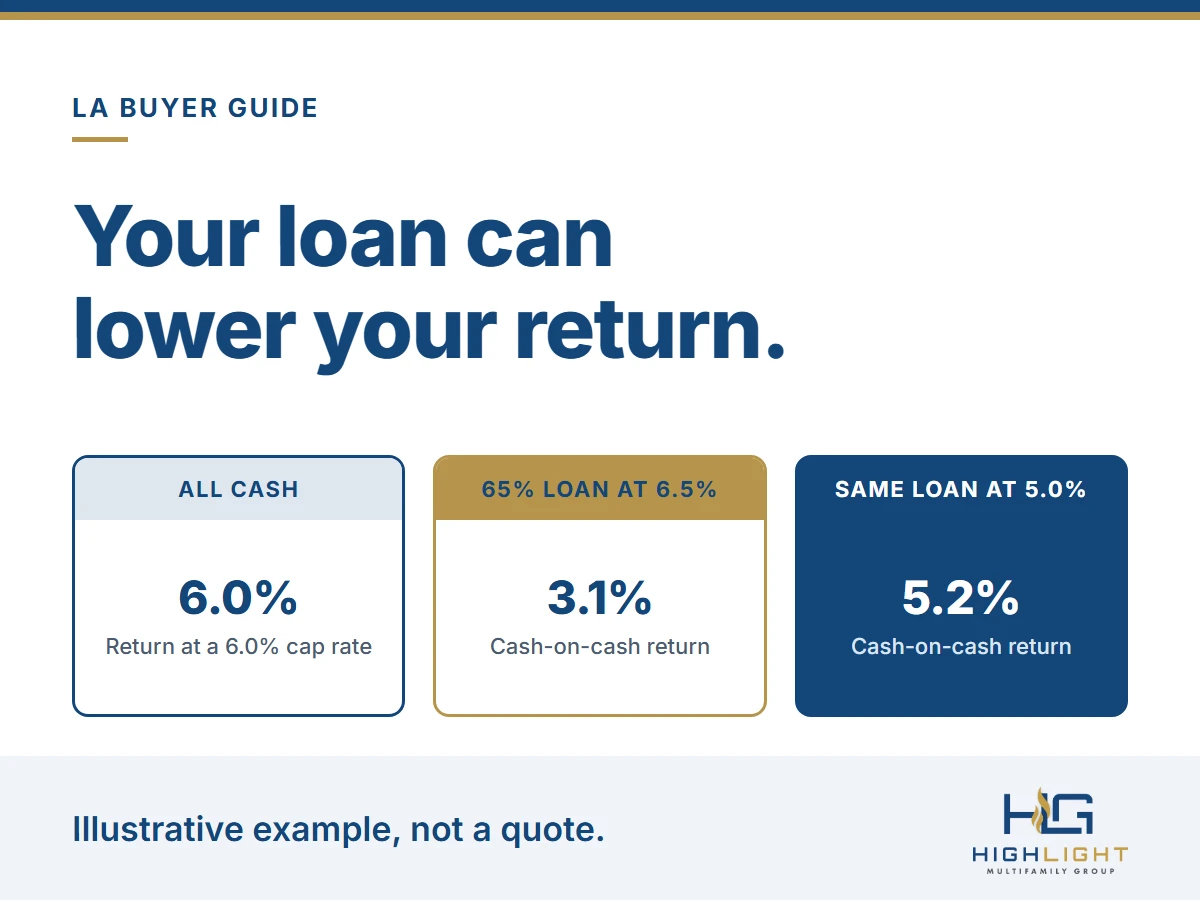
Buy it all cash and your return on the investment is the cap rate, 6.0%.
Now borrow 65%, or $1,560,000, on a 30-year loan at 6.5%. The payments come to about $118,300 a year, which leaves $25,700 of cash flow on $840,000 of equity, a cash-on-cash return of about 3.1%, and a debt service coverage ratio of 1.22.
The loan lowered the return, because it costs more than the building earns on the borrowed money. At a 5.0% rate, the same loan costs about $100,500 a year, and the cash-on-cash return rises to about 5.2%, with coverage of 1.43. Borrowing helps only when the rate is below the cap rate, or when you can raise the income. We go through the math in our guide to cap rate, cash-on-cash return, and GRM.
Financing and Your 1031 Exchange
If you are buying with the proceeds of a sale, your loan has to close inside the exchange timeline: 45 days to identify a replacement property and 180 days to close. Talk to a lender before you identify a property, not after, and read our 1031 exchange guide.
A Practical Order of Operations
Talk to two or three lenders before you start making offers, so you know the loan you can realistically get. Ask each for a quote on the kind of building you want, and compare rate, leverage, coverage, prepayment, and recourse. Once your offer is accepted, order the appraisal early, and line up the loan’s timeline with your due diligence period. Our due diligence checklist covers what to review while the loan is being underwritten.
This article is general information, not financial advice or a loan offer. Please confirm current programs, terms, and rates with a lender.
Frequently Asked Questions
How do I get a loan to buy an apartment building in Los Angeles?
Talk to two or three lenders before you make offers. Buildings with up to four units can generally be financed with residential mortgages, and buildings with five or more units need commercial loans. Agency programs, banks, credit unions, and bridge lenders are the main sources, and each lender’s quote should be compared on rate, leverage, coverage, prepayment, and recourse.
What is a DSCR, and what do lenders require?
The debt service coverage ratio is the building’s net operating income divided by the year’s loan payments. Lenders set a minimum, often somewhere around 1.2 to 1.35 times, and it varies by lender and loan. Ask your lender for the current figure.
How much can I borrow on an apartment building?
It depends on the lowest of the lender’s tests: a percentage of the building’s appraised value, and the loan that the net operating income can support at the minimum debt service coverage. The lender’s appraisal and your borrower profile also matter.
Can borrowing make my return on an apartment building worse?
Yes, when the loan’s rate is higher than the building’s cap rate. In our illustration, a 6.0% cap rate building financed at 6.5% returned about 3.1% on the buyer’s cash, compared with 6.0% all cash. The same loan at 5.0% returned about 5.2%.
Do lenders give credit for below-market rents in a rent-controlled building?
No. Lenders underwrite the rents in place, and they use their own assumptions for vacancy, expenses, and reserves. Under rent control the owner generally cannot raise rents to market while tenants remain.
What if I am buying with a 1031 exchange?
Your loan has to close inside the exchange timeline: 45 days to identify a replacement property and 180 days to close. Speak to a lender before you identify a property. See our 1031 exchange guide.