
LA Apartment Building Due Diligence Checklist for Buyers
Q4 2026
Key Takeaways
Due diligence is the period after your offer is accepted when you check everything the seller told you. In Los Angeles, the biggest surprises tend to come from the rent roll, the rent control status, deferred maintenance, and missing permits.
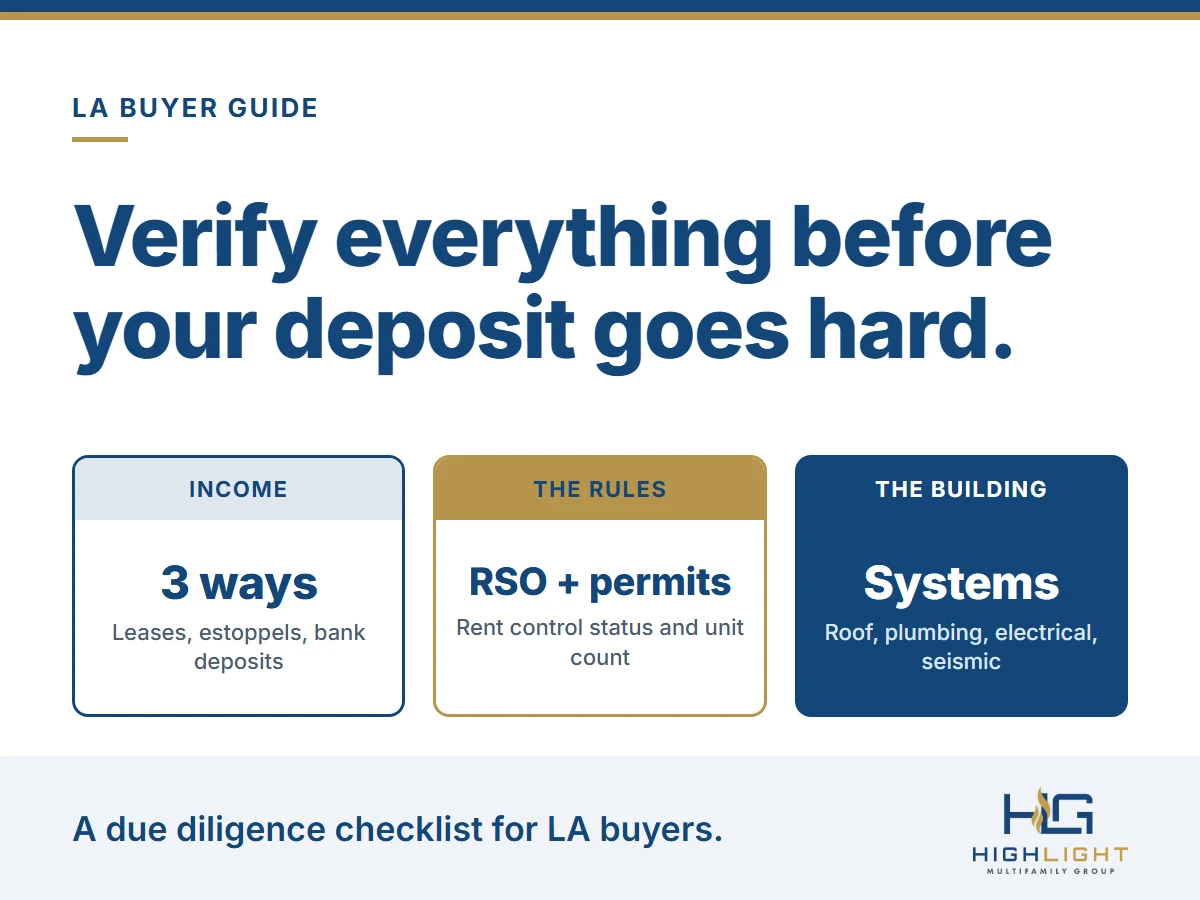
Verify income three ways: the rent roll, the leases and tenant estoppels, and the seller’s bank deposits.
Order the building’s legal and compliance records early, because some of them take time to arrive.
Anything you find is leverage. A good due diligence process ends in a lower price, a credit, or a decision to walk away before your deposit is at risk.
How the Due Diligence Period Works
Once the buyer and seller sign a purchase agreement and open escrow, the buyer has a set period to inspect the building and review its records before the deposit becomes non-refundable. The length of that period, the size of the deposit, and the buyer’s right to cancel are all negotiated, which is one reason the highest offer is not always the best one, as we explain in our guide to selling an apartment building step by step.
Start the work the day escrow opens. Requests for records, inspections, and loan appraisals each take days, and you will not have time to do them one after another.
1. Income: Check the Rent Roll Three Ways
The rent roll is the seller’s list of units, tenants, and rents. Treat it as a claim, not a fact. Compare it against the leases, against the tenant estoppels, which are short statements in which each tenant confirms their rent, deposit, and lease dates, and against the seller’s bank deposits for the last several months.
Look for rents that differ between documents, units listed as occupied that have no lease, tenants on month-to-month terms, free rent or concessions, and income from laundry or parking that is not in the rent roll. Ask for the last two to three years of income and expenses, and a trailing twelve-month statement.
On expenses, do not rely on the seller’s summary. Ask for the actual utility bills, insurance, property tax, repairs, and management costs, and add up what the building really costs to run. A water bill that crept up for a year can cost a buyer real value, as we show in our guide to utility bill diligence: at a 7% cap rate, $8,000 of extra yearly expense lowers a building’s value by about $114,000.
2. Rent Control and Tenant Law
Confirm which rules apply. In the City of Los Angeles, buildings with a certificate of occupancy issued before October 1, 1978 are generally covered by the Rent Stabilization Ordinance (RSO), and newer buildings typically fall under the statewide AB 1482 cap. You can look up an address on the City’s ZIMAS site, and the Housing Department answers questions at (866) 557-7368. Other cities, including Santa Monica, West Hollywood, and Beverly Hills, have their own rent control.
Ask for proof that the RSO registration and fees are current, a record of rent increases and the notices behind them, and a history of any no-fault evictions and relocation payments. Check the increases against what the law allowed at the time; our guides to the City’s 2026 RSO changes and the AB 1482 cap show the current limits. If the seller raised rents after a declared emergency, ask how they complied, since the rules are changing under SB 1365.
Also ask about any open or threatened tenant disputes, pending evictions, and the results of City code enforcement inspections, which are part of the Systematic Code Enforcement Program.
3. The Physical Building
Hire a licensed inspector, and add specialists where the building calls for them. In older Los Angeles buildings, the items that most often drive cost are:
Roof and drainage. Flat roofs, aging flashing, and clogged drains show up fast in a wet winter, as we describe in our El Niño checklist.
Plumbing. Older buildings may still have galvanized or cast-iron pipes. Ask for repair history and have a plumber scope the lines.
Electrical. Ask what panels the building has and whether any are brands inspectors flag. Our guide to air conditioning rules and electrical panels explains why it matters when tenants or landlords add cooling.
Seismic. Los Angeles requires retrofits of pre-1978 wood-frame soft-story buildings under a 2015 ordinance, so ask whether the building is covered and for proof that the work was done and permitted.
Balconies and stairs. If the building has three or more units with elevated wood-supported balconies, decks, or stairways, ask for the SB 721 inspection report and proof of any repairs. See our SB 721 guide.
Appliances. For leases entered into, amended, or extended on or after January 1, 2026, each unit needs a working stove and refrigerator under AB 628. Count the units that do not have them.
Lead paint. Federal law requires sellers of housing built before 1978 to disclose known lead-based paint hazards.
4. Permits and the Unit Count
Compare the number of units the City has on record with the number being rented. A unit that was added without permits can bring orders to correct or remove it, and it is a classic way for a building’s income to be overstated. Pull the permit history on ZIMAS and with the Los Angeles Department of Building and Safety, look for open permits and unpermitted work, and ask the seller to explain any difference.
5. Taxes, Insurance, and Transfer Costs
Property tax. A purchase triggers a reassessment. Proposition 13 sets the base rate at 1% of the purchase price, and voter-approved assessments and direct charges are added to it, so the seller’s current tax bill tells you very little about yours. Model your own.
Insurance. Get quotes before you remove contingencies. Ask for the seller’s claims history, since a building’s loss record affects the price and availability of coverage.
Transfer taxes. Check who pays under the contract. In the City of Los Angeles, the Measure ULA tax is figured on the gross price, including any loan the buyer assumes, so an assumed loan does not reduce it. See our Measure ULA guide and calculator. It matters to you twice: it can affect the seller’s pricing now, and it will affect your own exit later.
6. Title, Environmental, and Financing
Read the preliminary title report for liens, easements, and anything recorded against the property. If your lender or the building’s history calls for it, order an environmental report. Coordinate your loan appraisal early, because a lender’s appraisal that comes in below the price can force you to renegotiate or bring more cash. Our guide to financing an apartment building explains how lenders look at the building.
Red Flags
Rents on the rent roll that tenants or leases contradict.
Expenses that look too low, or a seller who will not provide actual bills.
No record of RSO registration, or increases that exceed what the law allowed.
Units that are rented but not on the City’s records.
Deferred maintenance that the seller describes as minor and the inspector does not.
A seller who resists estoppels or access to units.
Build the Right Team
Most buyers need a real estate attorney, a licensed inspector, a CPA, a lender, and a broker who knows the neighborhood. We represent buyers as well as sellers, and our closed sales page shows which side we were on in each deal. If you are weighing a building, you can contact us and we will walk through the numbers.
This article is general information, not legal, tax, or investment advice.
Frequently Asked Questions
What is due diligence when buying an apartment building?
It is the period after your offer is accepted when you inspect the building and verify the seller’s records before your deposit becomes non-refundable. The length of the period, the deposit, and your right to cancel are negotiated in the purchase agreement.
How do I verify the rent roll on an apartment building?
Compare it three ways: against the leases, against tenant estoppels in which each tenant confirms their rent, deposit, and lease dates, and against the seller’s bank deposits for the last several months. Also ask for two to three years of income and expenses.
How do I find out if an LA apartment building is rent controlled?
Buildings in the City of Los Angeles with a certificate of occupancy issued before October 1, 1978 are generally covered by the Rent Stabilization Ordinance. Look up the address on the City’s ZIMAS site, or call the Housing Department at (866) 557-7368. Other cities, such as Santa Monica, have their own rules.
What inspections should I order on an older LA apartment building?
A licensed general inspector, plus specialists as needed: a plumber to scope the lines, an electrician for the panels, a roofer, and a structural engineer where the building has soft-story or balcony concerns. Ask for the SB 721 balcony report and proof of any seismic retrofit.
Will my property taxes change when I buy an apartment building in California?
Yes. A purchase triggers a reassessment at the purchase price. Proposition 13 sets the base rate at 1%, and voter-approved assessments and direct charges are added, so the seller’s current bill tells you very little about yours.
What are the biggest red flags during due diligence?
Rents the leases or tenants contradict, expenses that look too low, no record of RSO registration, rented units missing from the City’s records, deferred maintenance the inspector rates worse than the seller does, and a seller who resists estoppels or unit access.